Steve Justice Studio

Art - Design

  • Home
  • Artist Statement
  • Bio and Exhibitions
  • Work
  • Contact

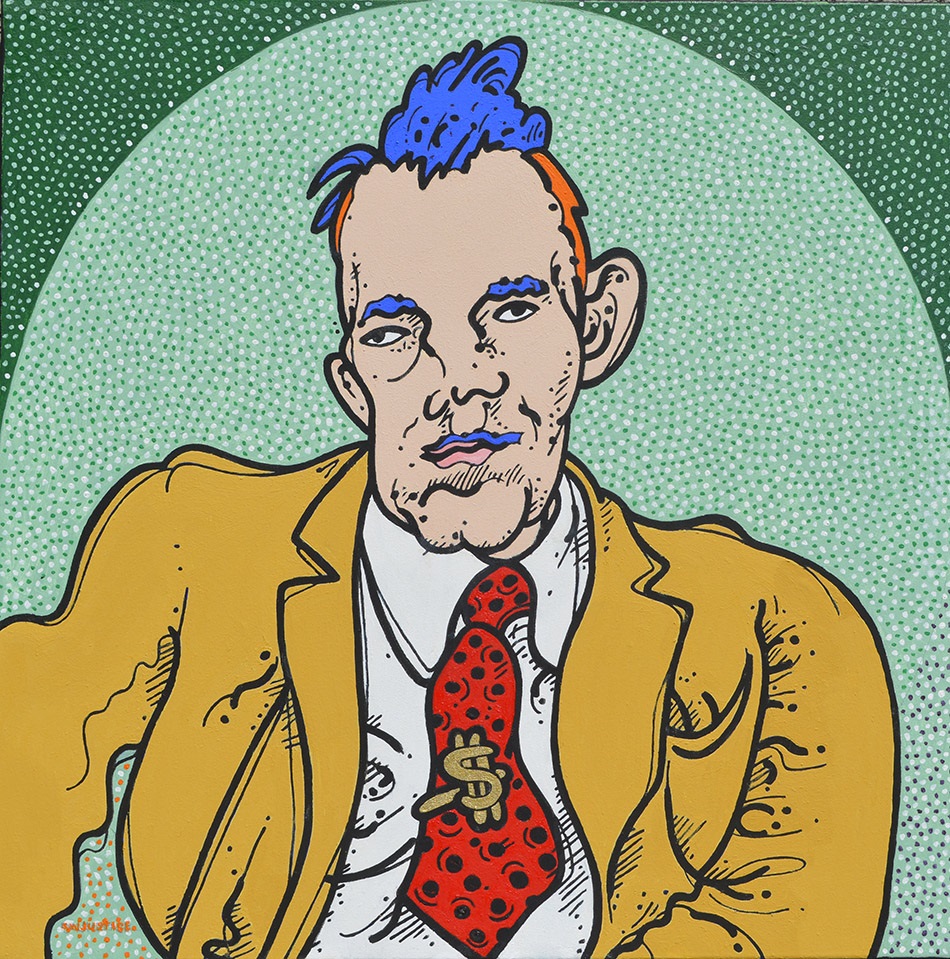
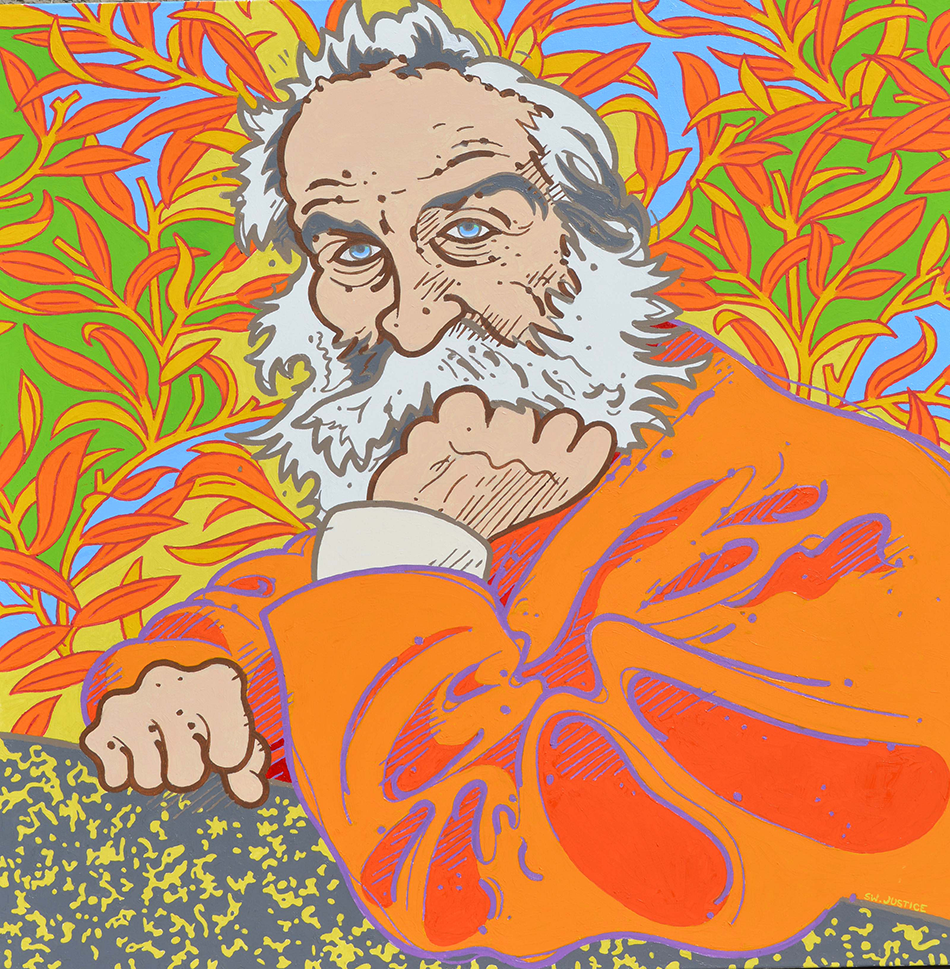
The Body Electric: portrait of Walt Whitman

November 17, 2020

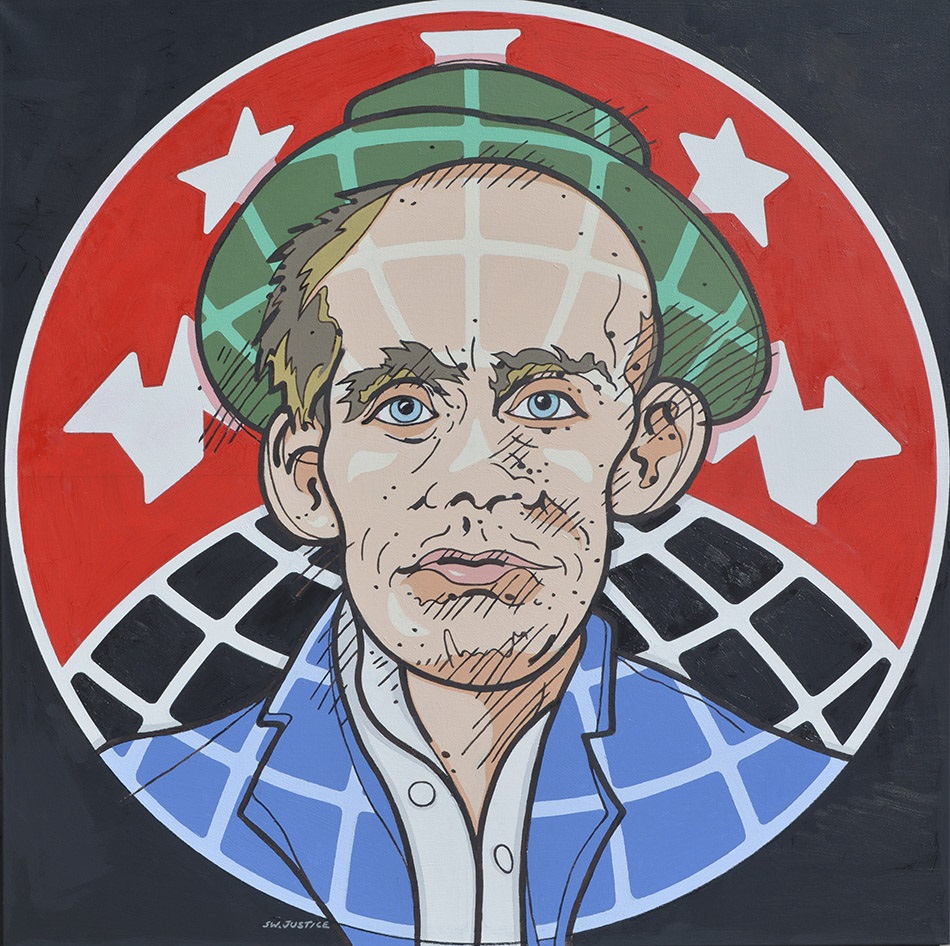
Title: The Body Electric: portrait of Walt Whitman
Material: Oil on canvas
Size: 36×36
Year: 2019    SOLD

There is no week nor day nor hour when tyranny may not enter upon this country, if the people lose their roughness and spirit of defiance.     — Walt Whitman

It was the poet Walt Whitman who invented free verse, radical socialist that he was.  Before that, verse was very expensive, costing at least $12 a barrel.  He was born in Huntington on Long Island, a town named after England’s Huntington, where Oliver Cromwell was born.  In high school, I once ran the 400 (and lost) to a kid named Oliver Cromwell, who was named after Oliver Cromwell.  Walt Whitman was named after an oversized bridge in Philadelphia.   We’ve come full circle now, so let’s progress.

Wally was a Civil War nurse, he was gay, and some people rhapsodically call him our first bohemian.  He wrote “Leaves of Grass”, which informed this fiery, psychedelicized portrait of the bardo bard, but any connection between psychedelics and grass in this painting is purely coincidental, so don’t go blabbling about that non-connection, okay?  Uncharacteristically, I used no black paint in the manufacture of this painting, which I found serves to turn up the heat a little.

A final word of warning:  If you ever open a box of Whitman’s Candy, do not eat the Savoy Truffle.  As George Harrison pointed out in the song of that name, you’ll have to have them all (your teeth) pulled out after the Savoy Truffle.  But the Coconut Fudge really blows down those blues.
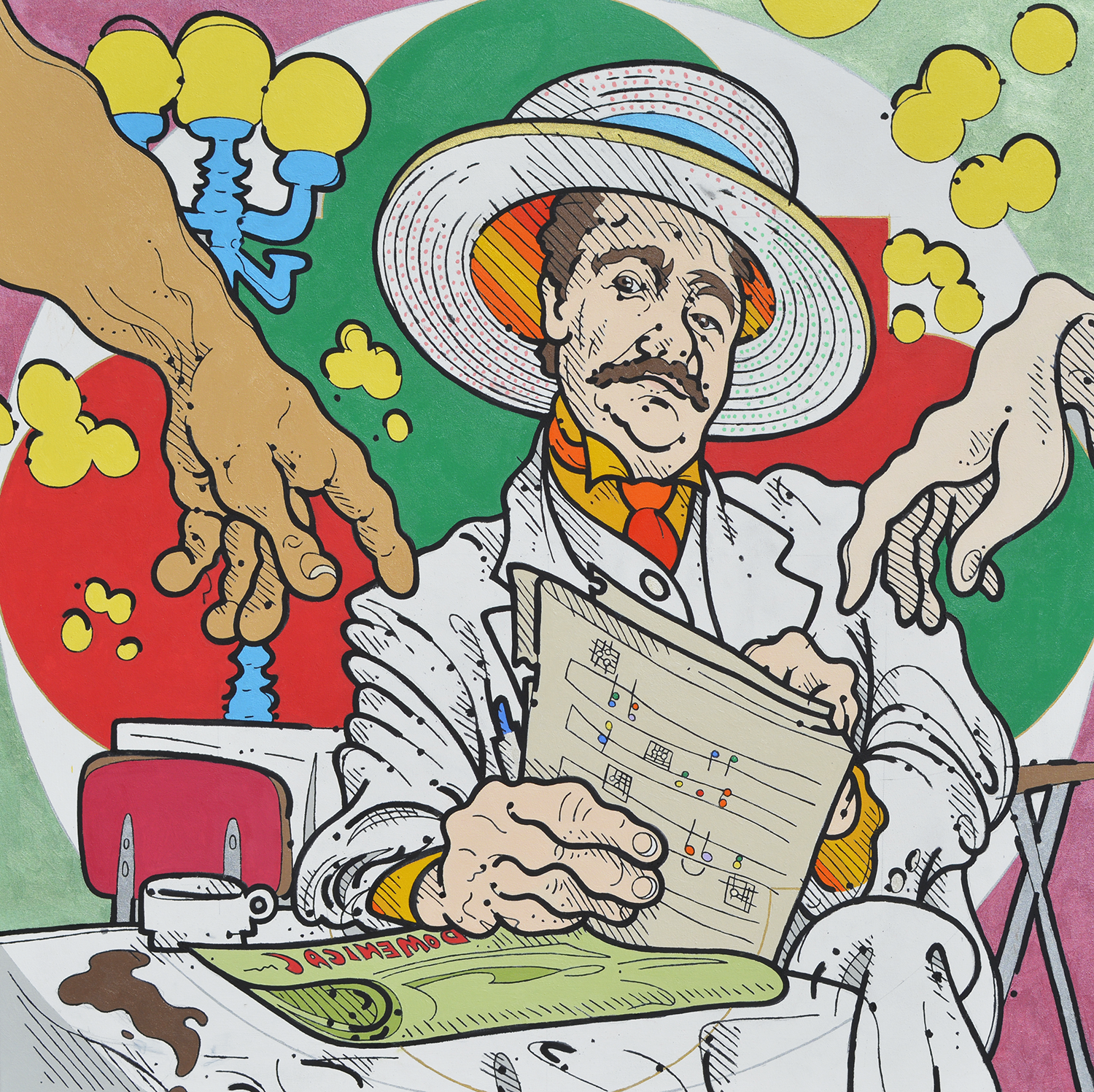


Teeny Weeny Puccini

August 25, 2020

Steve Justice Studio Title: Teeny Weeny Puccini (#2) Material: Oil on canvas Size: 48x48 Year: 2017 SoldTitle: Teeny Weeny Puccini
Material: oil on canvas
Size: 58×62
Year: 1997  SOLD

“Almighty God touched me with His little finger and said ‘Write for the theater, only for the theater.” — Giacomo Puccini

I take Puccini’s remark about his mission and show the artist as an intermediate between God and man. Europe’s café culture can stir up such philosophical musings.

His Cold, Dead Hands: portrait of Charlatan Heston

July 3, 2020

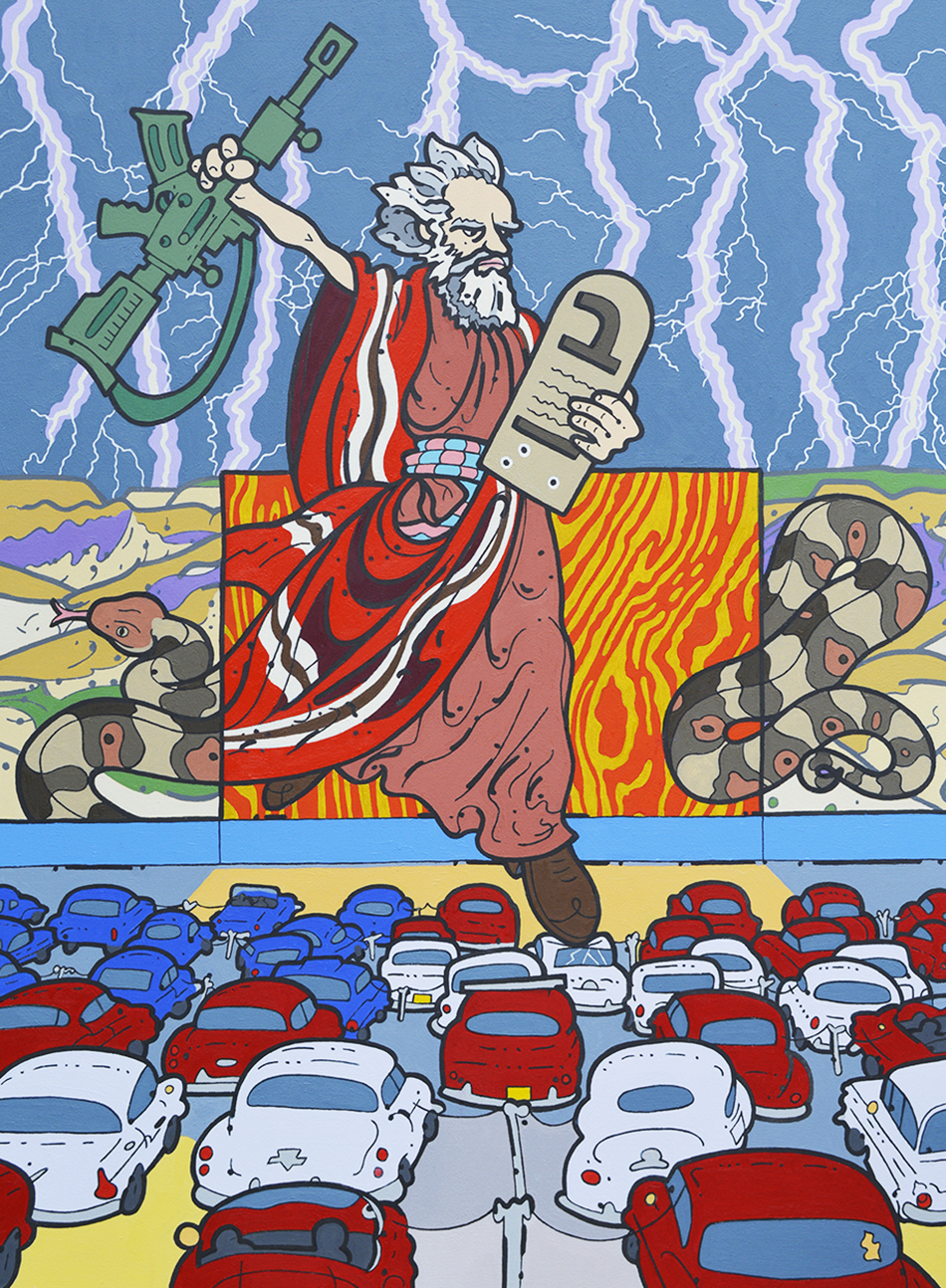
Title: His Cold, Dead Hands: portrait of Charlatan Heston
Material: Oil on canvas
Size: 60×44
Year: 2020

I’ll give you my gun when you pry it from my cold, dead hands.  – Charlton Heston  (on the first anniversary of the Columbine massacre)

Heston, we have a problem.  This painting began as Charlton Heston in his NRA* leadership role, brandishing an assault rifle, while also playing his signature movie role as Moses and carrying not the Ten Commandments, but rather the Second Amendment of the U.S. Constitution, which briefly and vaguely outlined our right to bear the Second Amendment of the Constitution two-and-a-half centuries ago.

Then occurred the awful murder of 11 worshipers at The Tree of Life – Or L’Simcha in my hometown of Pittsburgh, in 2018, during Shabbat services.   As usual, all the NRA did was dig in their cowboy boot heels on the issues of firearm ownership and regulation.  Their only cure is to arm everyone.  They have no plan B, C, D or F.  This painting evolved from there.   Or Stevolved, if you don’t believe in evolution.  And, since it’s a religious painting, I had no qualms about putting extra time into it.

Compositionally, you’ll notice that the painting is divided into three horizontal bands created by two overlapping squares, with all sorts of exciting activity crammed within.  Perspective is rolled flat, like Chinese landscape painting, or a Grandma Moses painting.  Of her own work, G.M. said “I paint from the top down.  First the sky, then the mountains, then the hills, then the cattle, then the people,” in a top-to-bottom hierarchy.  But unlike me, she never painted a religious subject, insisting that she “would not paint something we know nothing about”.  Speak for yourself, G.M.!

*not to be confused with the short-lived Depression-era National Recovery Administration, which was headed by General Hugh S. “Ironpants” Johnson, who didn’t want the job anyhow.  He was called Ironpants because he ironed his pants, I guess.  He later supervised WPA projects in New York City while working for another Moses – Robert Moses.  See how history gets all stuck together?

Wobbly: Portrait of Joe Hill Last Night

July 3, 2020

Wobbly: portrait of Joe Hill Last Night
Material: Oil on canvas
Size: 48×48
Year: 2020


A pamphlet, no matter how good, is never read more than once, but a song is learned by heart and repeated over and over.  And I maintain that if a person can put a few common-sense facts into a song and dress them up in a cloak of humor, he will succeed in reaching a great number of workers who are too unintelligent or too indifferent to read. – Joe Hill

When asked where he was born, Joe Hill would reply, “the planet Earth”.  Specifically, he was born in Scandinavia, more specifically Sweden, and even more specifically, in the town of Gavle.  He was named Joel Emmanuel Haggland.  He became a US immigrant, then a labor activist, specifically a Wobbly, which is a term of unknown origin adopted by the Industrial Workers of the World, or the IWW.  Specifically, his specialty was radical songwriting.  For those of you who wish to someday become a radical songwriter for a socialist labor union, his trick was to write new lyrics to familiar tunes, such as “Red River”, “Glory Hallelujah” or any Stephen Foster song, so all a singer had to do was read the lyrics from a little red book (of course) or fake it.

By 1914, Joe found himself in Utah, helping to organize copper miners.  He was arrested one evening for allegedly robbing and murdering a store clerk and was convicted on very thin evidence.  The only witness was a very imaginative 10-year-old boy.  Joe’s only link to any foul play was a bullet hole in his own right hand that was supposedly furnished by a clumsy brother-in-law, but Joe Hill doggedly refused to defend himself, choosing instead to die as a third-rate martyr.  The governor, who was eager to be rid of him, offered Joe a choice of the noose or the gun.  Joe chose both but got the latter.

As Joan Baez sang in the ballad ‘I Dreamed I Saw Joe Hill Last Night’ on the night she performed at Woodstock, “It takes more than guns to kill a man – I never died, said he.”  Well, he did and he didn’t.


Ready, Mr. Muzak?: portrait of Maj. Gen. George Owen Squier

July 3, 2020

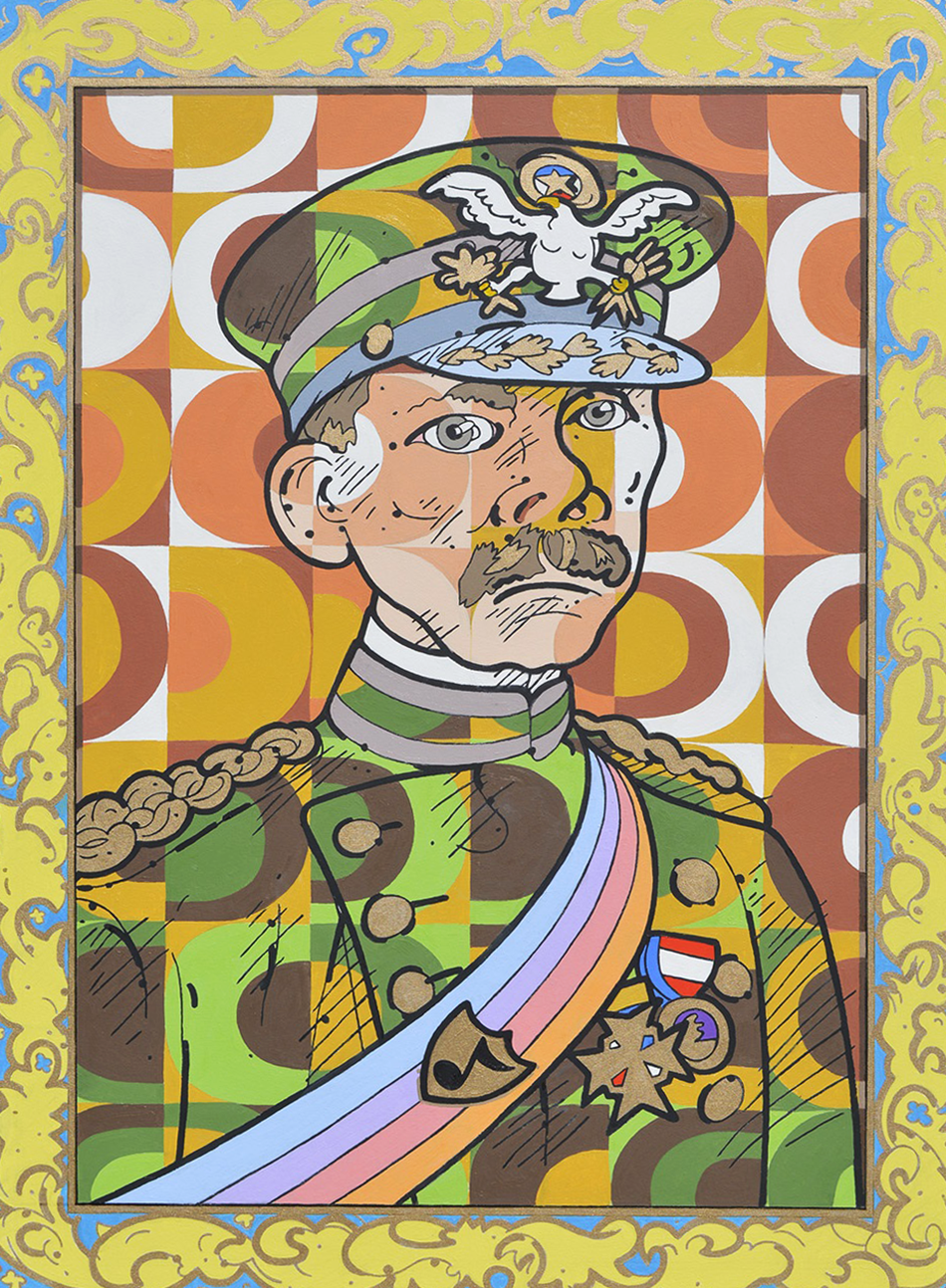
Ready, Mr. Muzak?: portrait of Maj. Gen. George Owen Squier
Material: Oil on canvas
Size: 48×36
Year: 2020

If you want to make beautiful music, you must play the black notes and the white notes together.     – Richard Nixon

Long, long ago in a universe far, far away, before the folk music scare of the early 1960s was even a twinkle in Bob Dylan’s eye, and even before the birth of rock-and-roll, background music was invented.  Easy Listening.  Elevator music.  Telephone on-hold music.  And we have General George Owen Squier to thank for it.  Thanks a lot, George.

General Squier invented telephone multiplexing in 1910 and acquired patents in 1922 for methods of distributing signals over existing electrical lines.  He saw the potential for this trick to deliver music to subscribers, without the need for a radio.  Radio caught up to him in the 1930s, so he concentrated his efforts on delivering music to commercial customers.  (All this happened in Cleveland, the town that takes radio seriously.)  In 1934, Squier named his company Muzak, because his product was music and he liked the name Kodak.  No other reason.  By then he’d learned manipulative musical tricks to ease worker-listener stress and to encourage productivity, as well to motivate shoppers.  He next began to record his own music, which became known as Muzak.

He was accused of brainwashing the public in the 1950s, but who wasn’t?  In the 60s and 70s, demand for Muzak became so huge that it found its way back into our most personal and holy sanctum, the private home.

Major General George Owen Squier was buried when he died (not before, though some were tempted) beside his mentor and protégé Major Uptick, in Arlington National Cemetery, which makes him John F. Kennedy’s equal.  But not JFK’s confederate – Robert E. Lee was the confederate, and the man who generously donated his vast front yard to become our nation’s most prestigious boneyard.  We thank you for this, Bobby.


The Hammer: portrait of Henry Aaron

July 3, 2020

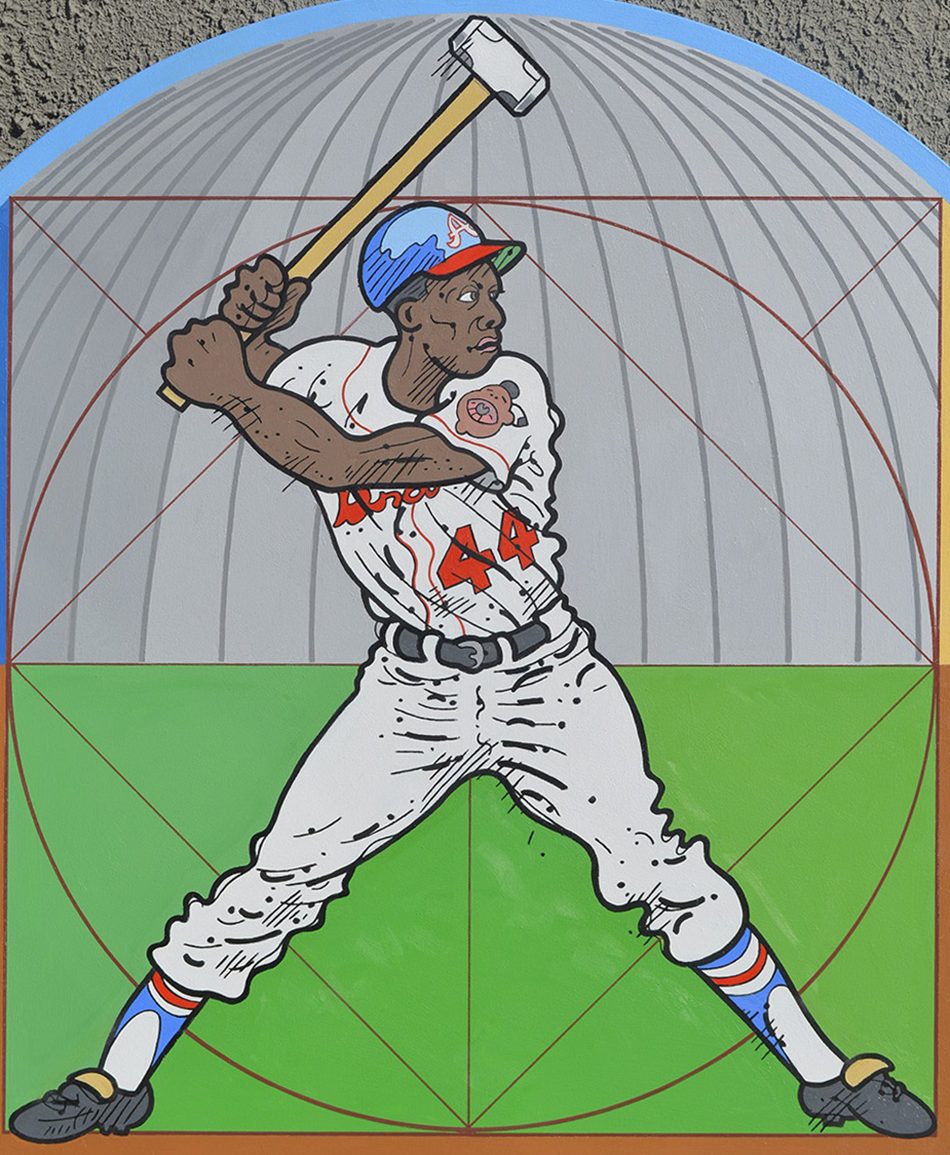
Title: The Hammer: portrait of Henry Aaron
Material: Oil on canvas
Size: 52×41
Year: 2020

On the field, blacks have been able to be super giants.  But, once our playing days are over, this is the end of it and we go back to the back of the bus again.     – Henry Aaron

Roman designer and architect Marcus Vitruvius Pollio wrote a book on architecture, which was reprinted 15 centuries later and inspired countless Renaissance artists and architects, including Leonardo da Vinci, who became intrigued by the relationship between man and earth and based much of his work on Vitruvian analogies.  “All the arts and all the world’s rules are devised from a well-composed and proportioned human body,” wrote Francesco di Giorgio, who is not shown in this painting and who I won’t mention again.  Leonardo’s notes on his Vitruvian Man drawing are, as usual, written backwards (from right to left) not because he wanted to stump the reader, as is rumored – any jackass could crack that code – but because he was left-handed and he was tired of smearing ink around with his writing hand.

Henry Aaron was right-handed, and was arguably the best hitter of that persuasion in Big League history.  He was also the Negro League’s greatest product who made the Majors.  Aaron began his pro career in 1951 at the age of 17, with the Indianapolis Clowns.  They weren’t exactly clowns, though they were not averse to novelty.  They had a midget on the roster called Spec Bebop, and an excellent 2nd– basewoman named Toni Stone, who took Aaron’s place after his change of employers. He Northernly Migrated to Milwaukee to play outfield for the Braves, only to move South again when they became the Atlanta Braves.  He continued to work his magic and make baseball history there despite receiving something like 20,000 death threats a day.  (* That might be an exaggeration, but 2,000 might not be.)  So here he is, playing the part of Leonardo da Vinci’s perfect man, taking his hacks in front of Georgia’s famous landmark, Stone Mountain, prior to its grotesque disfiguration.

Public Emeny #1

July 3, 2020

Title: Public Emeny #1
Material: Oil on canvas
Size: 30×30
Year: 2015-20

Justice is incidental to law and order.     – J. Edgar Hoover

… A mere by-product of law and order, the top cop says.

In this re-animation of a police photo of the recently-martyred holey-man John Dillinger, I experimented with water-based oil paint due to studiostic spatial restraints at the time, but I later over-painted it with the good stuff.

The green arch in the painting plays multiple roles, suggesting an engraved image on US currency, or every bank teller’s nightmare (or wet dream) of John Dillinger waiting at their window to make a withdrawal.  The hair is just him being cool, but the precise colors were suggested by a Florida Gators fan.  Yes, there are still a few of them around — Isn’t that cute?

Dillinger was only 31 when he was gunned down as three of five shots struck him in front of the Biograph Theater in Chicago, where he and a hot date in a red dress had gone to see Bonnie and Clyde.   (Correction: They had just seen Manhattan Melodrama, starring the apish, jug-eared, fast-talking former tire-builder from Akron, and future WWII flyboy, Clark Gable.)  Just a few months earlier Dillinger had famously escaped from jail in Princeton, Illinois, where he was being given a time out for doing a whole lot of bad things.  Legend has it that he broke out of jail by threatening the guards with a fake gun that he’d carved out of a tomato.  He more than likely threatened them with $100 bills.  Shoot me if I’m wrong.

Queen of the Roller Derby: Portrait of RBG

July 2, 2020

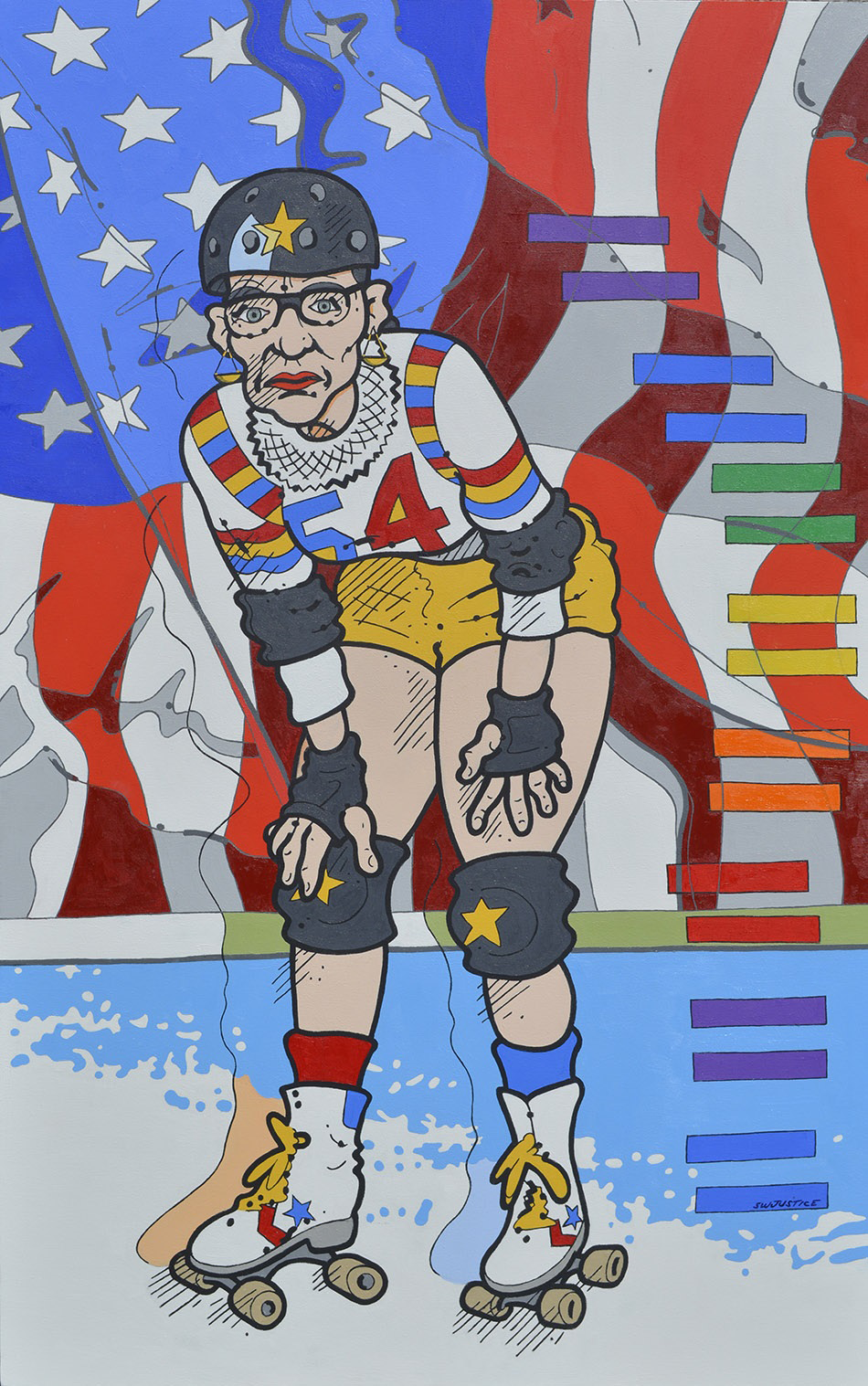
Queen of the Roller Derby: portrait of RGB
Material: Oil on canvas
Size: 70×44
Year: 2020   SOLD

Fight for the things that you care about, but do it in a way that will lead others to follow you.     – Ruth Bader Ginsberg

I don’t know what I can tell you about this painting that I don’t already know.  I am (and you may also be) a fan of the fiery woman who became the second female U.S. Supreme Court justice, Ruth Bader Ginsberg, who argued against gender discrimination in 6 landmark cases while winning recognition as being an engine of liberal dissent.  She voiced her principles and wouldn’t back down, stand down or step down, and we are all the beneficiaries.

Her roll as a Roller Derby Queen in this painting reflects her competitiveness, and the Star-Spangled Banner behind her, as well as the United Skates on America on her feet, symbolize the country she loved.  The 54 on her uniform might refer to her year of graduation from Cornell, but it also carries the suggestion of a 5-4 Supreme Court decision.  The “speed lines” behind her (to the right) are an ancient comic strip gimmick used to suggest movement of an otherwise stationary object or person.  Think of Sluggo chasing an ice cream truck.  These lines I turn into “equality” symbols, like those the ACLU uses, here paired into colors of diversity.  (Btw, RBG co-founded the ACLU’s Women’s Rights Project in 1972.)

RBG’s pose and detailing were inspired by a photo of Joannie Weston, aka the “Blonde Bomber”, a real Queen of the Roller Derby who rolled for the San Francisco Bay Bombers.  Joannie once hit 8 home runs in a college softball game.  (Her team must have scored at least 24 runs in this game.)

The first thing that happened when I posted this painting on the fridge was,  dozens of roller derbiers came out of the woodwork, all aclamor with purchase inquiries.  And I’d better accommodate them because there probably isn’t a one of them who couldn’t beat me to within an inch of my wife.


Outrider: portrait of Anne Waldman

November 17, 2019

Title: Outrider: Portrait of Anne Waldman
Material: Oil on canvas
Size: 36×36
Year: 2019

Yep, Comanch’: portrait of John Ford

November 17, 2019

Steve-Justice-Studio-Yep, Comanch'

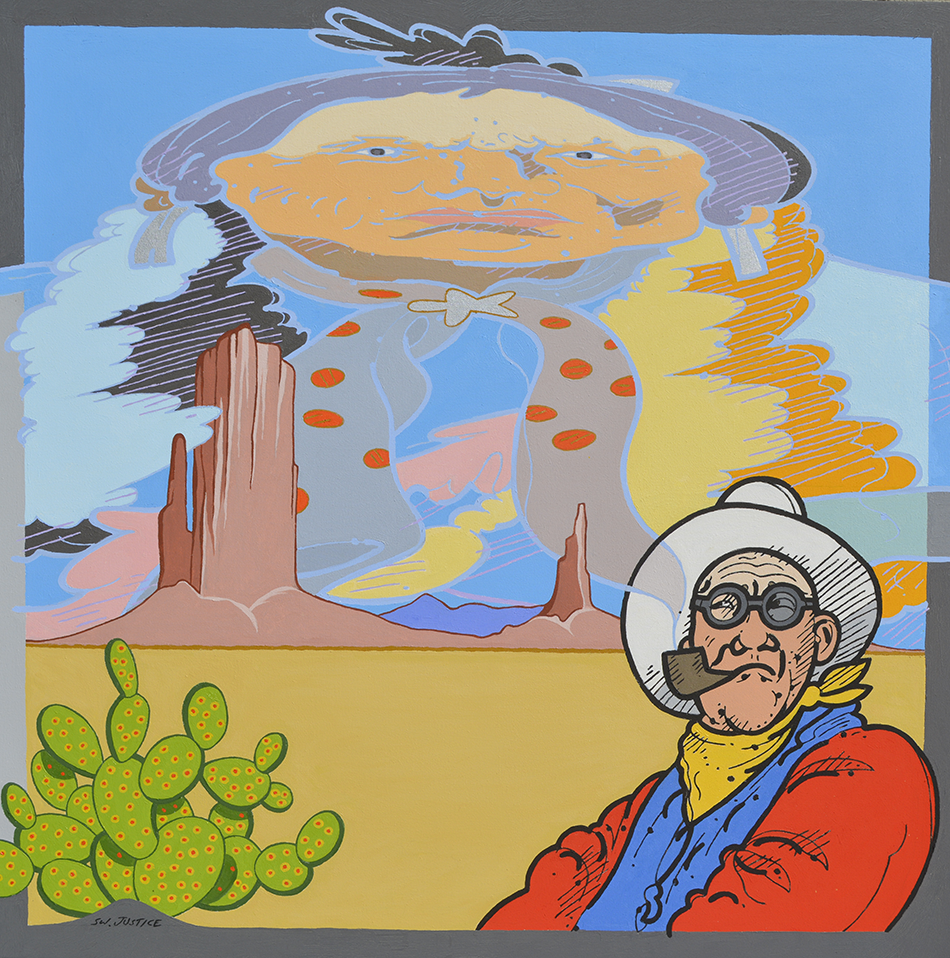
Title: Yep, Comanch’: portrait of John Ford
Material: Oil on canvas
Size: 42×42
Year: 2019

It is easier to get an actor to be a cowboy than to get a cowboy to be an actor.     – John Ford

This painting started out as a triple portrait of John Ford, Henry Ford and John Henry, three folk celebrities linked forever by name into a strange hedron representing working men of varying ethnicities and religiosities.  But the project unraveled as the three subjects drifted apart, each into his own separate painting, with Henry Ford in one, Hammerin’ Henry Aaron filling in for Hammerin’ John Henry in another, and filmmaker John Ford as the subject of this painting.

John Ford’s pictures differ from my pictures in that his moved.  They were moving pictures.  Mine might juke around a little bit but they rarely go very far.   Most of the time they don’t even leave the room.   In recent paintings I’d been permitting the backgrounds to assume a more dominant role in the composition, and this one pushes the subject almost entirely out the frame.  I have combined in this background Ford’s trademark “big sky” style panorama with a Hanna-Barbera “Queeksdraw” desert and the loathsome shitstorm thunderheads so eloquently captured in much contemporary Western art.  Upstaging Ford is the great Comanche chief, Quanah Parker, whose heart marks this painting’s center.  Ford’s movies frequently pitted Comanches vs. cowboys or cavalry in Monument Valley, which is actually Navaho land.  In fact, John Ford’s “Comanche” extras generally spoke Navaho, not Comanche.  But what do we know?

Ford said it is easier to get an actor to play a cowboy than to get a cowboy to be an actor.  No John Ford painting would be complete without a mention of his go-to fake cowboy, John Wayne, so here Ford wears Wayne’s shirt, in living Technicolor, from The Searchers (1956), a picture in which his character (Ethan Edwards) is slighted by Indians and mahem ensues.  And you thought Denzel Washington acted crazy in Training Day.

Yippee yi yo ki yay!


  • Newer
  • 1
  • 2
  • 3
  • 4
  • 5
  • 6
  • …
  • 14
  • Older

Copyright 2025 Steve Justice Studio | Site design handcrafted by Station Seven