Steve Justice Studio

Art - Design

  • Home
  • Artist Statement
  • Bio and Exhibitions
  • Work
  • Contact

Public Emeny #1

July 3, 2020

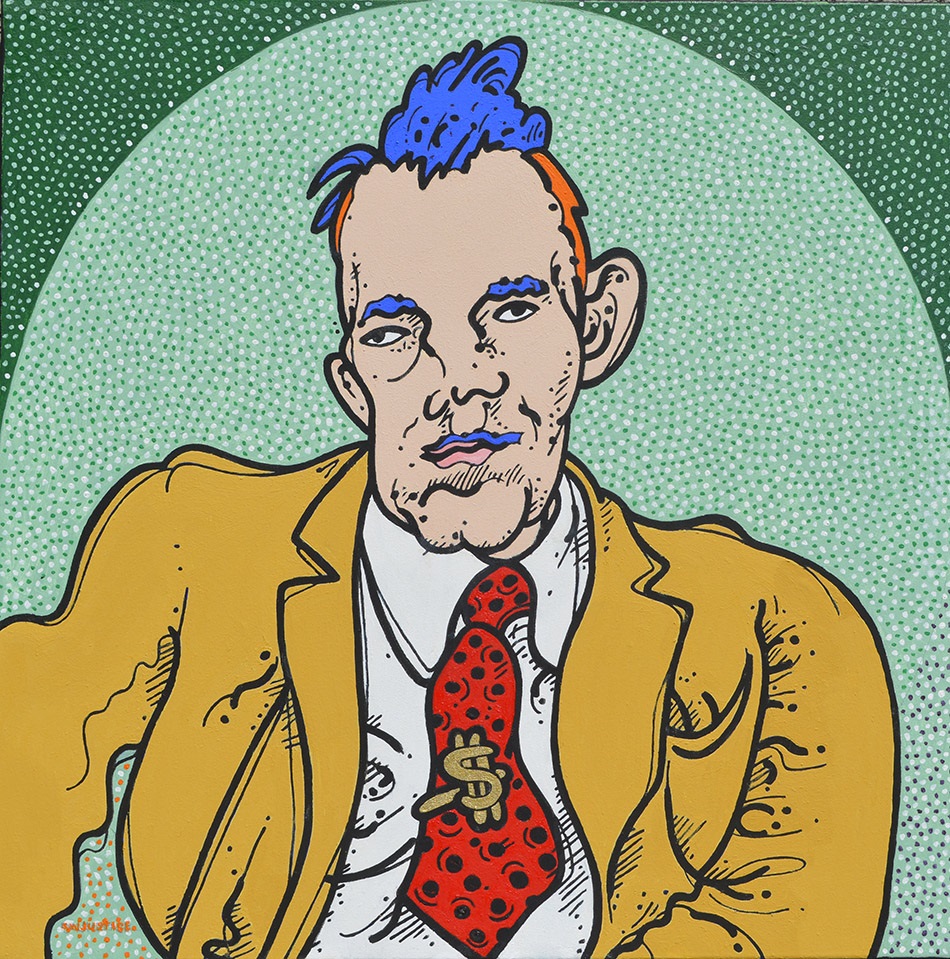
Title: Public Emeny #1
Material: Oil on canvas
Size: 30×30
Year: 2015-20

Justice is incidental to law and order.     – J. Edgar Hoover

… A mere by-product of law and order, the top cop says.

In this re-animation of a police photo of the recently-martyred holey-man John Dillinger, I experimented with water-based oil paint due to studiostic spatial restraints at the time, but I later over-painted it with the good stuff.

The green arch in the painting plays multiple roles, suggesting an engraved image on US currency, or every bank teller’s nightmare (or wet dream) of John Dillinger waiting at their window to make a withdrawal.  The hair is just him being cool, but the precise colors were suggested by a Florida Gators fan.  Yes, there are still a few of them around — Isn’t that cute?

Dillinger was only 31 when he was gunned down as three of five shots struck him in front of the Biograph Theater in Chicago, where he and a hot date in a red dress had gone to see Bonnie and Clyde.   (Correction: They had just seen Manhattan Melodrama, starring the apish, jug-eared, fast-talking former tire-builder from Akron, and future WWII flyboy, Clark Gable.)  Just a few months earlier Dillinger had famously escaped from jail in Princeton, Illinois, where he was being given a time out for doing a whole lot of bad things.  Legend has it that he broke out of jail by threatening the guards with a fake gun that he’d carved out of a tomato.  He more than likely threatened them with $100 bills.  Shoot me if I’m wrong.
Queen of the Roller Derby: Portrait of RBG

July 2, 2020

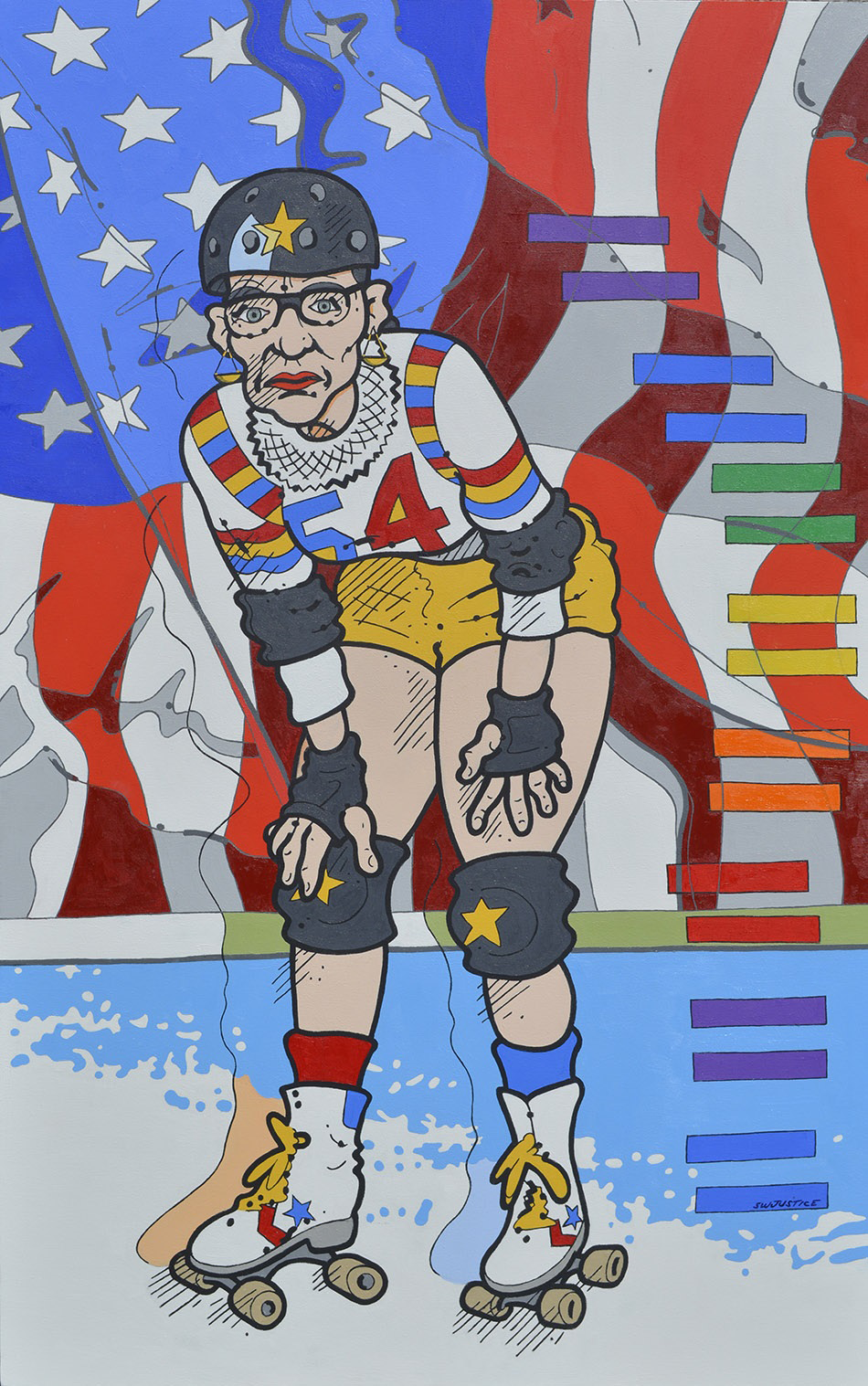
Queen of the Roller Derby: portrait of RGB
Material: Oil on canvas
Size: 70×44
Year: 2020   SOLD

Fight for the things that you care about, but do it in a way that will lead others to follow you.     – Ruth Bader Ginsberg

I don’t know what I can tell you about this painting that I don’t already know.  I am (and you may also be) a fan of the fiery woman who became the second female U.S. Supreme Court justice, Ruth Bader Ginsberg, who argued against gender discrimination in 6 landmark cases while winning recognition as being an engine of liberal dissent.  She voiced her principles and wouldn’t back down, stand down or step down, and we are all the beneficiaries.

Her roll as a Roller Derby Queen in this painting reflects her competitiveness, and the Star-Spangled Banner behind her, as well as the United Skates on America on her feet, symbolize the country she loved.  The 54 on her uniform might refer to her year of graduation from Cornell, but it also carries the suggestion of a 5-4 Supreme Court decision.  The “speed lines” behind her (to the right) are an ancient comic strip gimmick used to suggest movement of an otherwise stationary object or person.  Think of Sluggo chasing an ice cream truck.  These lines I turn into “equality” symbols, like those the ACLU uses, here paired into colors of diversity.  (Btw, RBG co-founded the ACLU’s Women’s Rights Project in 1972.)

RBG’s pose and detailing were inspired by a photo of Joannie Weston, aka the “Blonde Bomber”, a real Queen of the Roller Derby who rolled for the San Francisco Bay Bombers.  Joannie once hit 8 home runs in a college softball game.  (Her team must have scored at least 24 runs in this game.)

The first thing that happened when I posted this painting on the fridge was,  dozens of roller derbiers came out of the woodwork, all aclamor with purchase inquiries.  And I’d better accommodate them because there probably isn’t a one of them who couldn’t beat me to within an inch of my wife.


Yep, Comanch’: portrait of John Ford

November 17, 2019

Steve-Justice-Studio-Yep, Comanch'

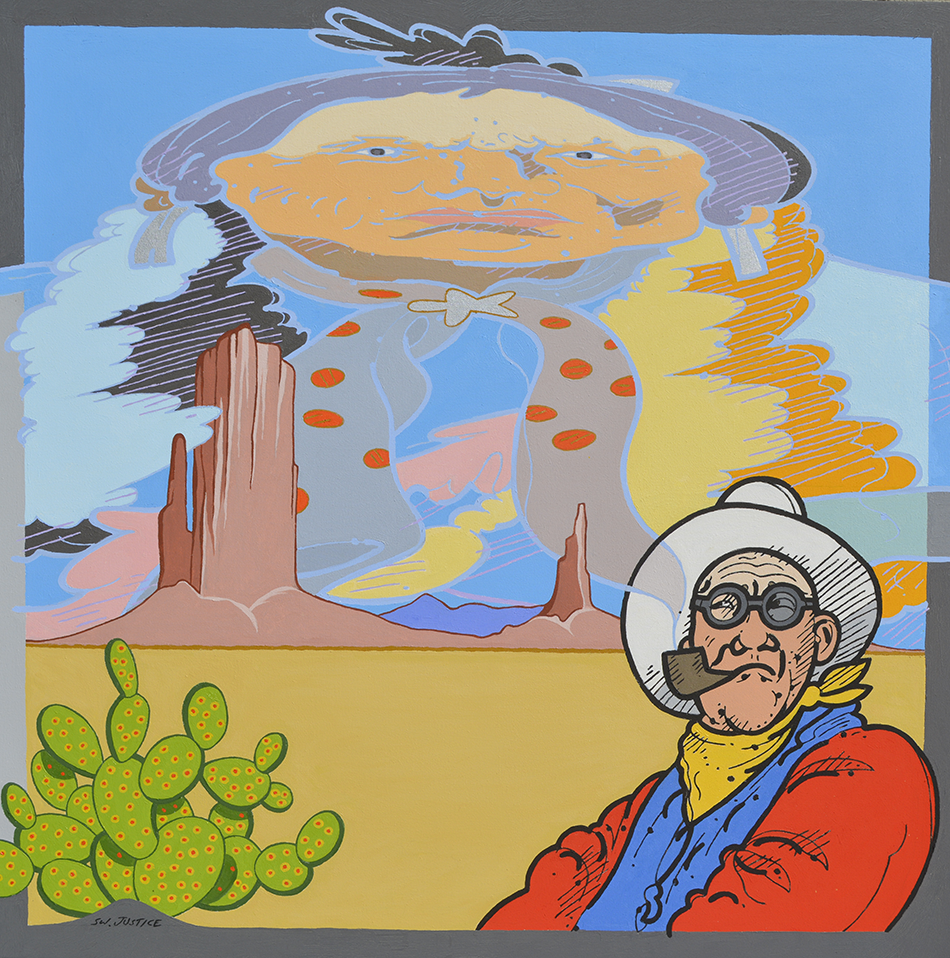
Title: Yep, Comanch’: portrait of John Ford
Material: Oil on canvas
Size: 42×42
Year: 2019

It is easier to get an actor to be a cowboy than to get a cowboy to be an actor.     – John Ford

This painting started out as a triple portrait of John Ford, Henry Ford and John Henry, three folk celebrities linked forever by name into a strange hedron representing working men of varying ethnicities and religiosities.  But the project unraveled as the three subjects drifted apart, each into his own separate painting, with Henry Ford in one, Hammerin’ Henry Aaron filling in for Hammerin’ John Henry in another, and filmmaker John Ford as the subject of this painting.

John Ford’s pictures differ from my pictures in that his moved.  They were moving pictures.  Mine might juke around a little bit but they rarely go very far.   Most of the time they don’t even leave the room.   In recent paintings I’d been permitting the backgrounds to assume a more dominant role in the composition, and this one pushes the subject almost entirely out the frame.  I have combined in this background Ford’s trademark “big sky” style panorama with a Hanna-Barbera “Queeksdraw” desert and the loathsome shitstorm thunderheads so eloquently captured in much contemporary Western art.  Upstaging Ford is the great Comanche chief, Quanah Parker, whose heart marks this painting’s center.  Ford’s movies frequently pitted Comanches vs. cowboys or cavalry in Monument Valley, which is actually Navaho land.  In fact, John Ford’s “Comanche” extras generally spoke Navaho, not Comanche.  But what do we know?

Ford said it is easier to get an actor to play a cowboy than to get a cowboy to be an actor.  No John Ford painting would be complete without a mention of his go-to fake cowboy, John Wayne, so here Ford wears Wayne’s shirt, in living Technicolor, from The Searchers (1956), a picture in which his character (Ethan Edwards) is slighted by Indians and mahem ensues.  And you thought Denzel Washington acted crazy in Training Day.

Yippee yi yo ki yay!


There’s a Red Horse Over Yonder

November 17, 2019

Steve-justice-Studio-There's-A-Red-Horse-Over-Yonder

Steve-justice-Studio-There's-A-Red-Horse-Over-Yonder

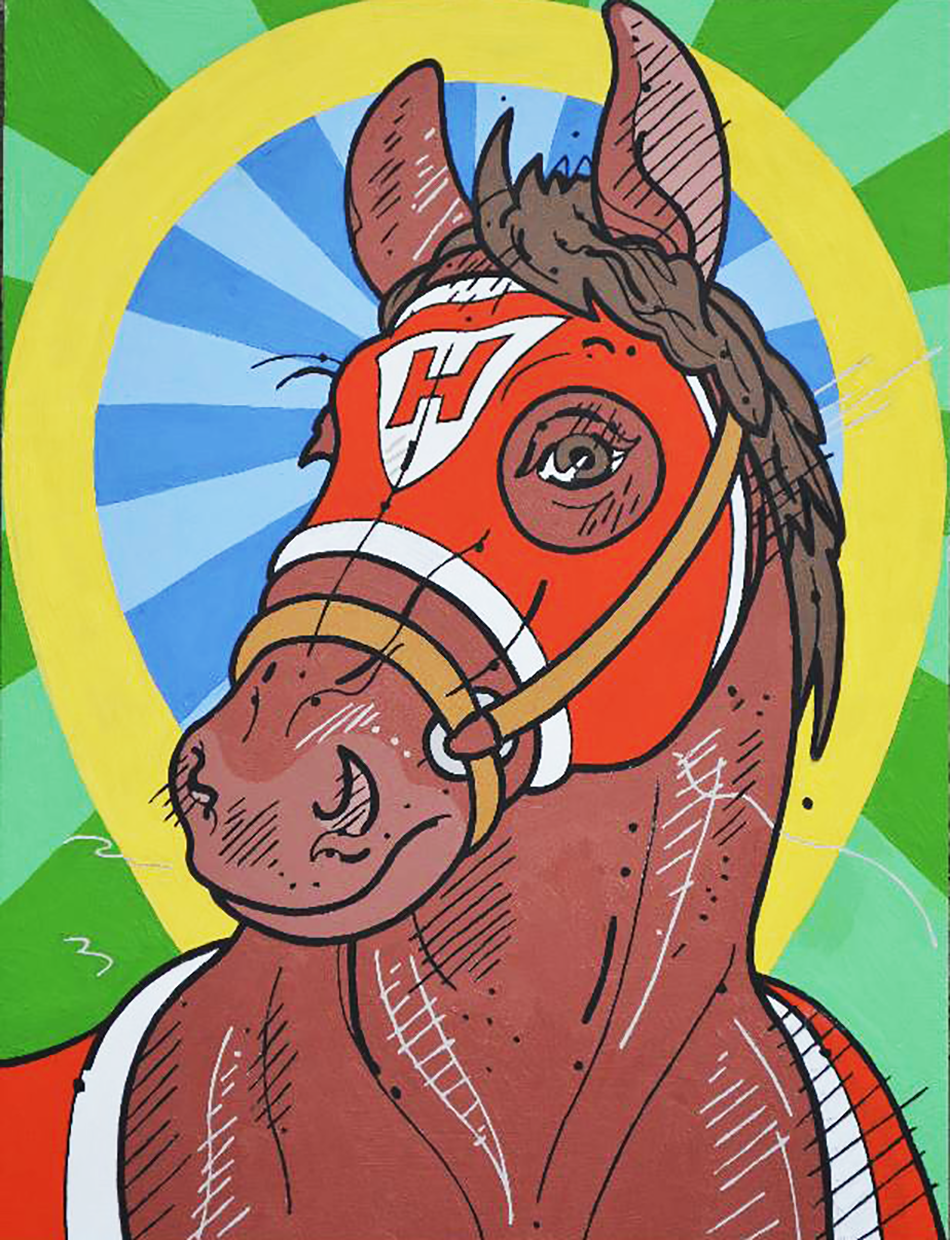
There’s a Red Horse Over Yonder
Material: Oil on canvas
Size: 34×24 (8×6 hands)
Year: 2017

The horse is too small, the jockey too big, the trainer too old, and I’m too dumb to know the difference.    – Charles Howard  (Seabiscuit’s owner)

Seabiscuit’s job was to (literally) run for his life.  In his first 100 races, the racehorse never once finished in the money, and he was headed for the proverbial (or actual) glue factory in a (metaphorical) handbasket until he came under proper management and training.  Stubborn, little, gnarly and eccentric, he was a most unlikely racehorse to one day be setting long-standing track records.  Jockey Red Pollard said his greatest thrill was feeling Seabiscuit accelerate.  He felt like he was on an airplane rather than a horse.

Seabiscuit was particular.  He always insisted on bedding down at night with his pets: a goat, a dog and a duck.  I started doing likewise, and my life has improved immeasurably, as long as Ducky remembers his C-pap machine.

In this painting, I bend earth and sky in the background into a horseshoe halo to show the strange, inside-out world that domesticated animals live in.  The colors go all garish and checkerboardy, because that seems to be the look horseracing arrived at.  By dressing the animal something like a Mexican wrestler, with his trademark branded hood, I make a crack about Seabiscuit’s early career, racing in Tijuana.  But I am also speaking of animal domestication.  We own them, we dress them as we please, we make of them tools and playthings and billboards, and they teach us how to love.

Seabiscuit’s cocky gaze I caught in a horse’s eyes in the paddock of Hong Kong’s Happy Valley racetrack.  The horse told me he wanted to run and was going to win, and he did, and I earned some money through this interspecies clairvoyance.   Afterward, he and I went to Wanchai to drink beer and watch the fillies walk by.  He drank me under the stable.  Hay, we’re only human!


Sherpa – Portrait of Tenzing Norgay

November 17, 2019

steve-justice-studio-Tutti-Fruitti-prosecutti

steve-justice-studio-Tutti-Fruitti-prosecutti

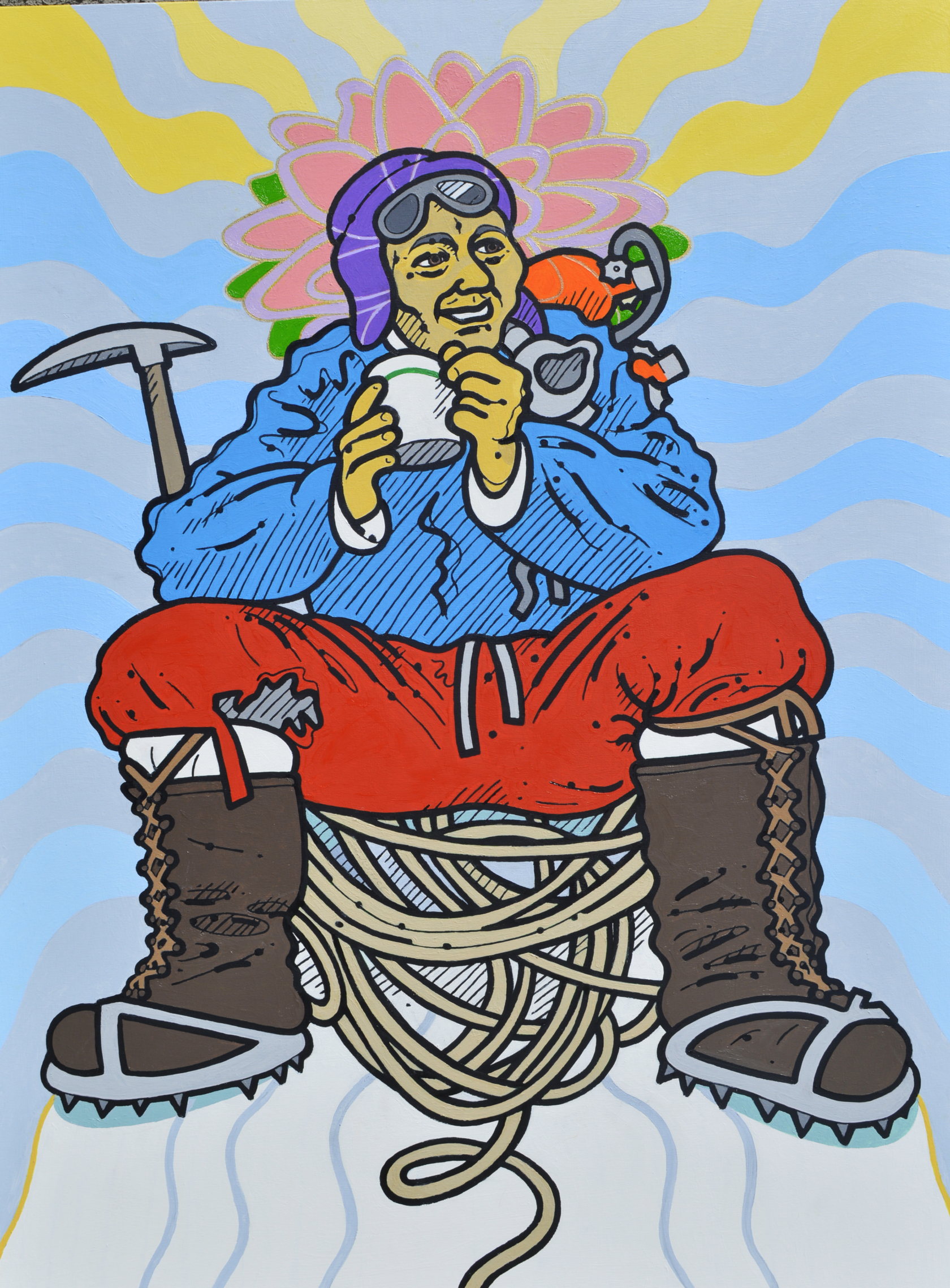
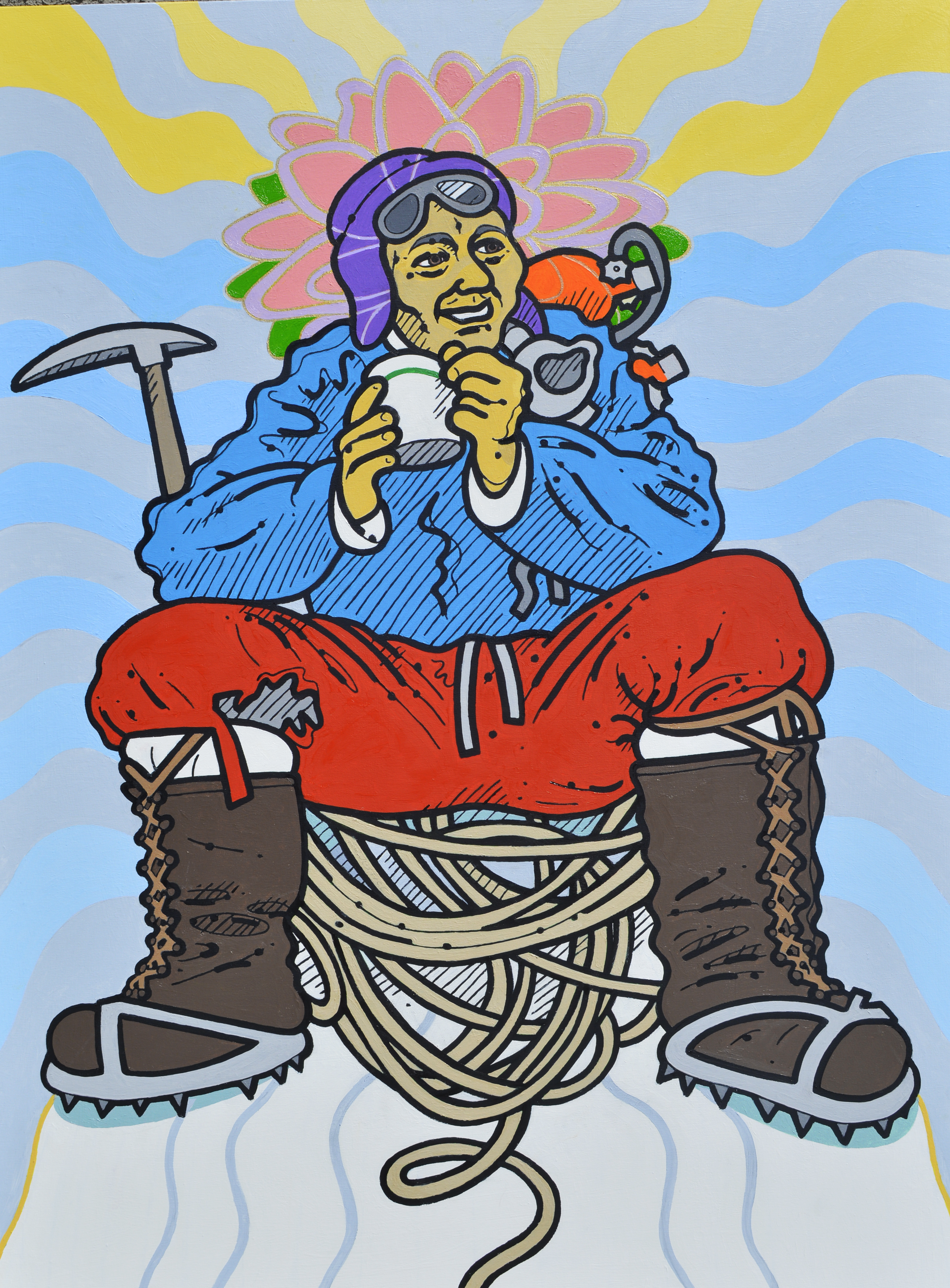
 Sherpa, Portrait of Tenzing Norgay
Material: Oil on canvas
Size: 48×36
Year: 2019

I have never regarded myself as a hero, but Tenzing undoubtedly was. – Sir Edmund Hillary

Could you repeat that, Sir Edmund, only a little louder this time?

Once upon a time, climbing the world’s highest mountains, the Himalayas, was a challenge, so climbers would hire local Sherpas to help.  These Sherpas were experienced climbers themselves, with low pulse rates and noives of steel.  Every Nepalese boy wanted to be a Sherpa for the prestige, the money, and the surplus equipment.  A Sherpa jocking around with his ropes, goggles, and thick climbing boots was the envy of everyone.  It was a ticket out of the dull, unpromising life they faced as small-time herders.

There is no evidence, photographic or otherwise, that Sir Edmund Hillary, reputedly the first person to reach the summit of Mount Everest (in 1953), ever did so.  But there are pictures he took of his Sherpa, Tenzing Norgay, the Tiger of the Himalayas, standing on the summit, waving and planting a flag.  Just sayin’.

Neither man knew they’d be the ones selected to make the final assault, since an expedition would send up the climber and Sherpa most likely to finish the job.  The best horses on the track.  So, it could have been anyone other than Hillary and Tenzing, who were in the right place in the right shape at the right time.  Tenzing would have been okay with it either way, I opine, because he had already been to the summit of Mount Everest many times.    Nepalese sherpas were the first climbers to scale K2 in the wintertime, you know That’s my theory, which is as thin as air at 26 thousand feet.

For further study:  The Himalaya mountain range was formed by the Indian Plate slowly (over 250,000,000 years) crashing into the Eurasian Plate.  India is still moving at a pace of an inch per year, so we can expect India to one day be east of China.


Tutti Frutti Prosecutti: Sacco and Vanzetti

November 17, 2019

steve-justice-studio-Tutti-Fruitti-prosecutti

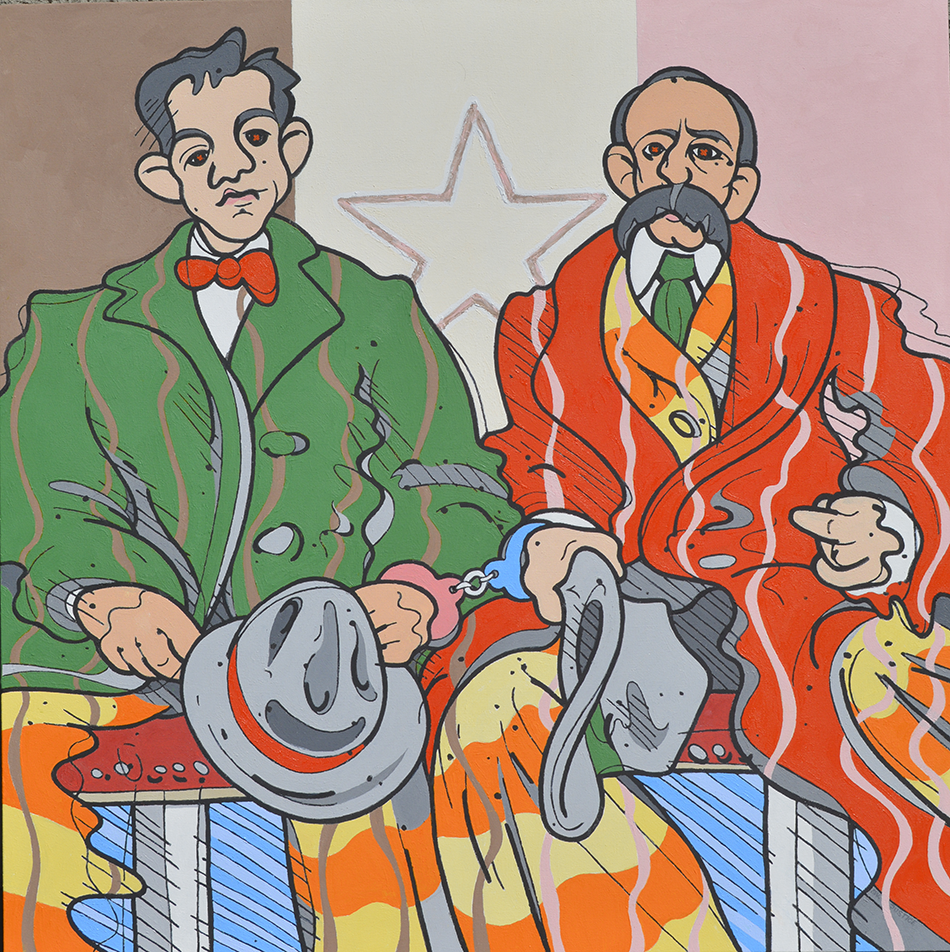
Title: Tutti-Fruitti Prosecutti: Sacco and Vanzetti
Material: Oil on canvas
Size: 42×42
Year: 2018

There is the best man I ever cast my eyes upon since I lived, a man that will last and will grow always more near to and more dear to the heart of the people, so long as admiration for goodness, for virtues, and for sacrifice will last.  I mean Eugene V. Debs.   – Bartolomeo Vanzetti

Unpopular ethnic group + Unpopular politics = The usual suspects.


Nicola Sacco and Bartolomeo Vanzetti are as inseparable in our minds as Bonnie & Clyde.  Dean Martin & Jerry Lewis.  Caspar and Pollux.  The Smothers Brothers.  Republicans and sexism, or Chang and Eng (* Barnum’s co-joined twins — sick, I know).  In this painting I correct the order in which our heroes are usually photographically shown, by placing Sacco on the left and Vanzetti on the right.   The gagootz and the hot-head.  They showed up every day in the courtroom daily for the seven years of their trial, dressed like governors and courteously removing their hats for judges, ladies, photographers and executioners.

Neapolitan ice cream in the background plays the part of the Italian flag, though neither man was Neapolitan, nor were they crazy about Neapolitan ice cream.  I’ve noticed that few Italians are.  While they were in jail, they both preferred limon gelato with a double espresso after their secondi plata.

I feel I captured Sacco & Vanzetti about as well as an artist can, but the Bridgewater, Massachusetts Police captured them first.  Coincidentally, both men died on the same day, on August 23, 1927.  They didn’t even have to be uncuffed.  Both were innocent, but Vanzetti deserved the noose for his outrageous moustache alone.  Don’t be too impressed — his sister’s was even bigger.  Mi scusi!

Beggars Can’t be Chaucers

November 17, 2019

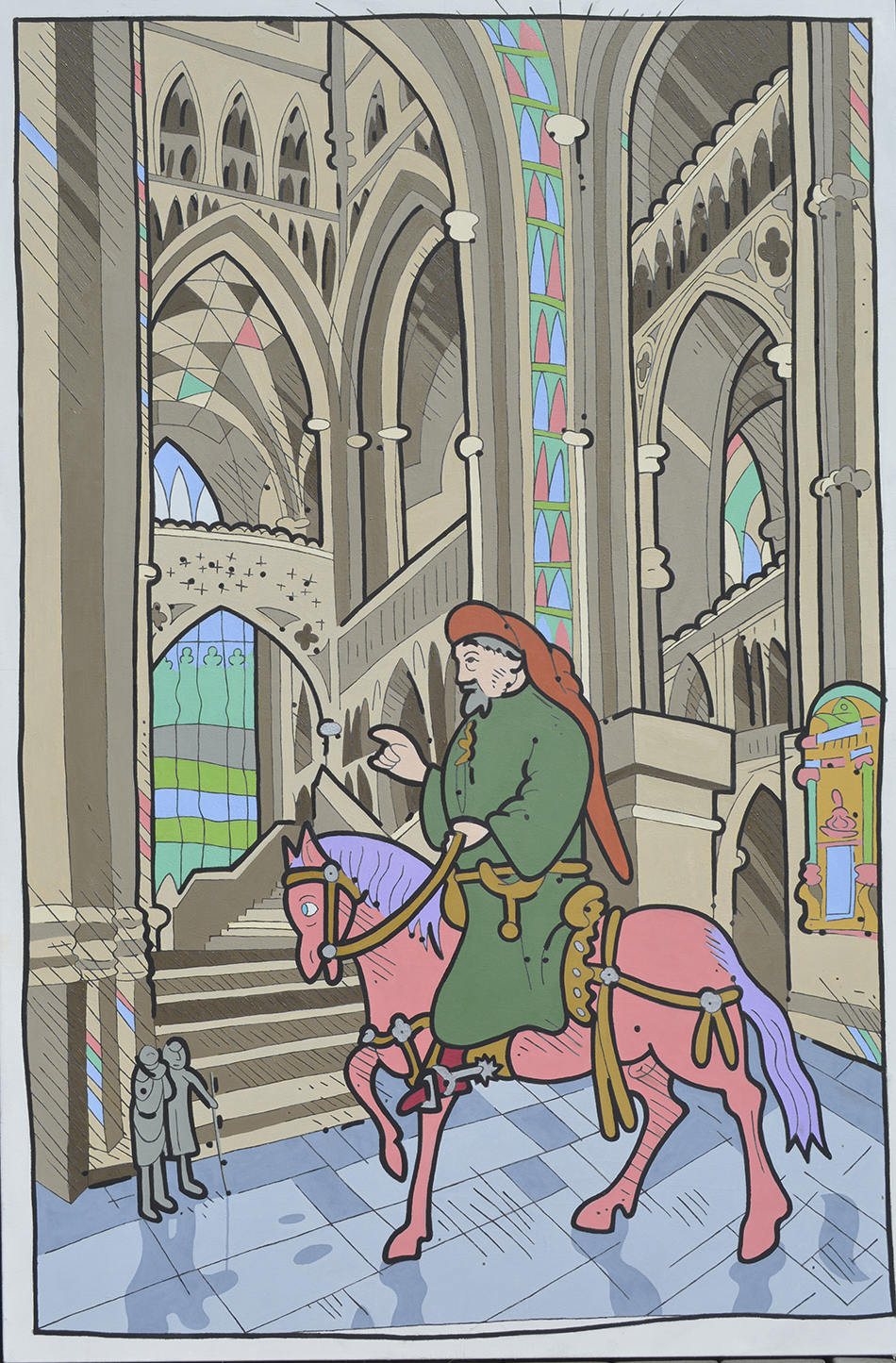
Title: Beggars Can’t Be Chaucers
Material: Oil on canvas
Size: 72×48
Year: 2016-2019

“By God,” quod he, “for pleynly, at a word, Thy drasty ryming is nat worth a toord!”     — Geoffrey Chaucer

Goeffrey Chaucer writen Canterbury Tales and some other things, including a body of poetry big enough to fil a Penguin anthology.  Yes, that big, and he writen all those shorter poems during a single two-week bender.


With style and mood nicked from illuminated manuscripts and cathedrals themselves, a pilgrimage unto Canterbury is here shown with Goeffrey himself in his own tale, confronting pitous beggars.  But Chaucer was nat so class-conscious.  Although he was a good accountant, his career checking wool exports for tax purposes was nat as lucrative as his boss Richard the Gaunt hoped it would be for the two of them, due to Chaucer’s integrity.  This also caused a lyfelong rift between him and his wyf, who really got off on being a Lady in the Queen’s court and lived highly in digs north of London, while her housbonde shivered in government housing inside a city gate with stoon wals 13 feet thick and arrow slits for windwes.  But it was the perfect place for a government accountant to brood between manic outbursts of writing.

In the top half of this peynting, soaring vaults describe the vertical, bigger-than-man sense one experiences in an ancient cathedral.  All that, just to keep reyn off the backs of people who are preyest.  As for the color, I tried to peynt the cathedral’s echo, and Canterbury Cathedral does look like it’s built out of tons upon tons of echo.

The rendering of figures in old manuscripts always looks so amateurish and cartoony to our eyes, that even the horses resemble toys, so I took the next logical step and turned Geoff’s hors into the toy, My Pretty Pony, which adds levity to all this medieval ponderance.  Levity and branding.  I rely on the hors to put the canter into Canterbury.

Lester in Love

November 17, 2019

steve-justice-studio-lester-in-love

steve-justice-studio-lester-in-love

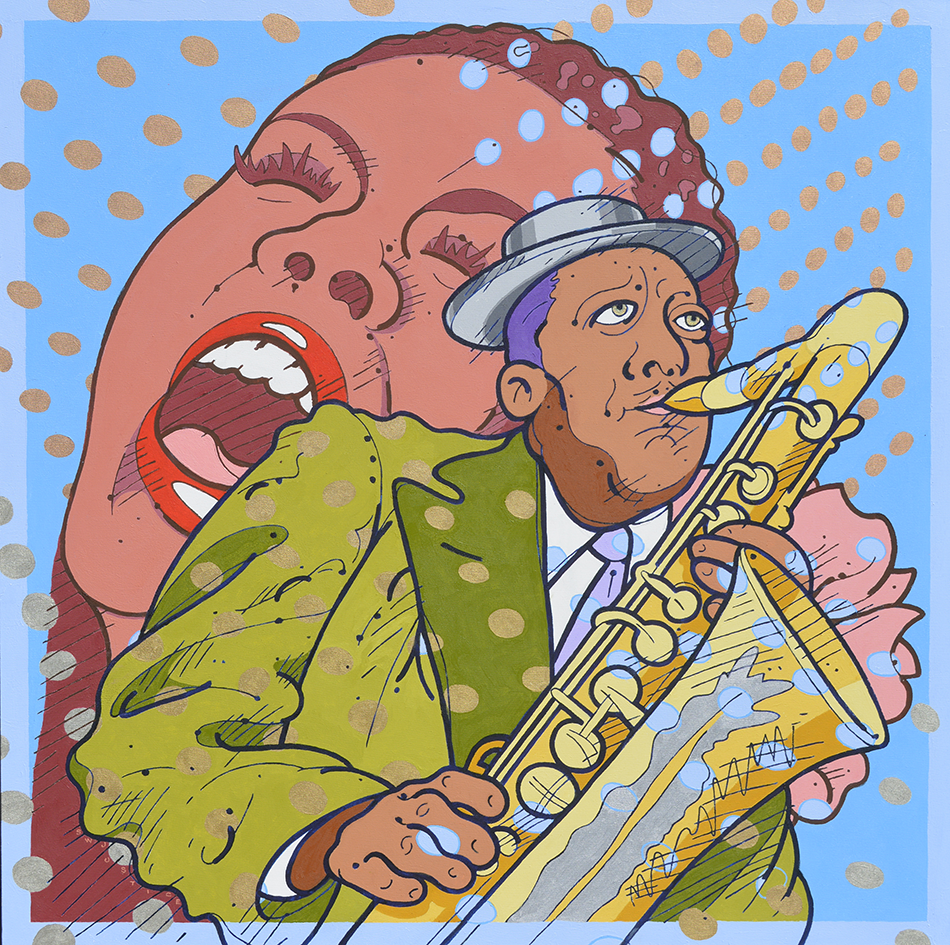
Lester in Love: Portrait of Lester Young and Billie Holiday
Material: Oil on canvas
Size: 48×48
Year: 2018

I’d been studying the microphone for a dozen years, and I suddenly saw what I’d been doing wrong.  I’d been singing too loud.  One night I was listening to a record by Lester Young, the horn player, and it came to me.  Relax, just relax.  It’s going to be all right.     – Marvin Gaye

In this painting I explore a successful “musical romance”, which are rarely romances in a traditional sense, but can be just as passionate when they work.  In musical (or other artistic) romances, the energy between the two parties squares itself so their combined result is far in excess of the sum of their individual talents.  That club is legendary:  Marvin Gaye & Tammy Terrill, Mimi & Richard Farina, Sonny & Cher, Lennon & McCartney (bromance), Prince & himself, The Mamas and the Papas, and numerous others.  The phenomenon does not stretch to encompass all collaborations.  The efforts of the Travelling Wilburies, for instance, exceed in quality none of its band members individual efforts.

In the case of Pres and Lady Day (Lester Young and Billie Holiday), though they did love one another, the romance was purely creative and ended whenever the music did, as both parties suffered through disfunctions and were bugled to Jesus way before their time.  They both drank themselves to death, at 49 and 44.  Lester Young served in the Jim Crow army in WW2 and was traumatized by the experience.  Psychologically, he was never the same.  God Bless the Child.

Some of their art found its way into my portrait of them with “Pennies from Heaven” pouring in from four vanishing points and creating “Polka Dots and Moonbeams”.  (These are all songs of theirs.)  “My Funny Valentine” is a broken heart, tilted to one side.  “Lester Leaps In” and lines and colors plow through the painting somehow as if in an improvised leap of faith.  I toy with scale, and perspective and feigned double exposure (as I often do in other paintings) to add to the composition some jangle and deliberate contradiction.  Or not.


Look to See to Remember: portrait of Joseph C. Fitzpatrick

November 17, 2019

steve-justice-studio-look-to-see-to-remember


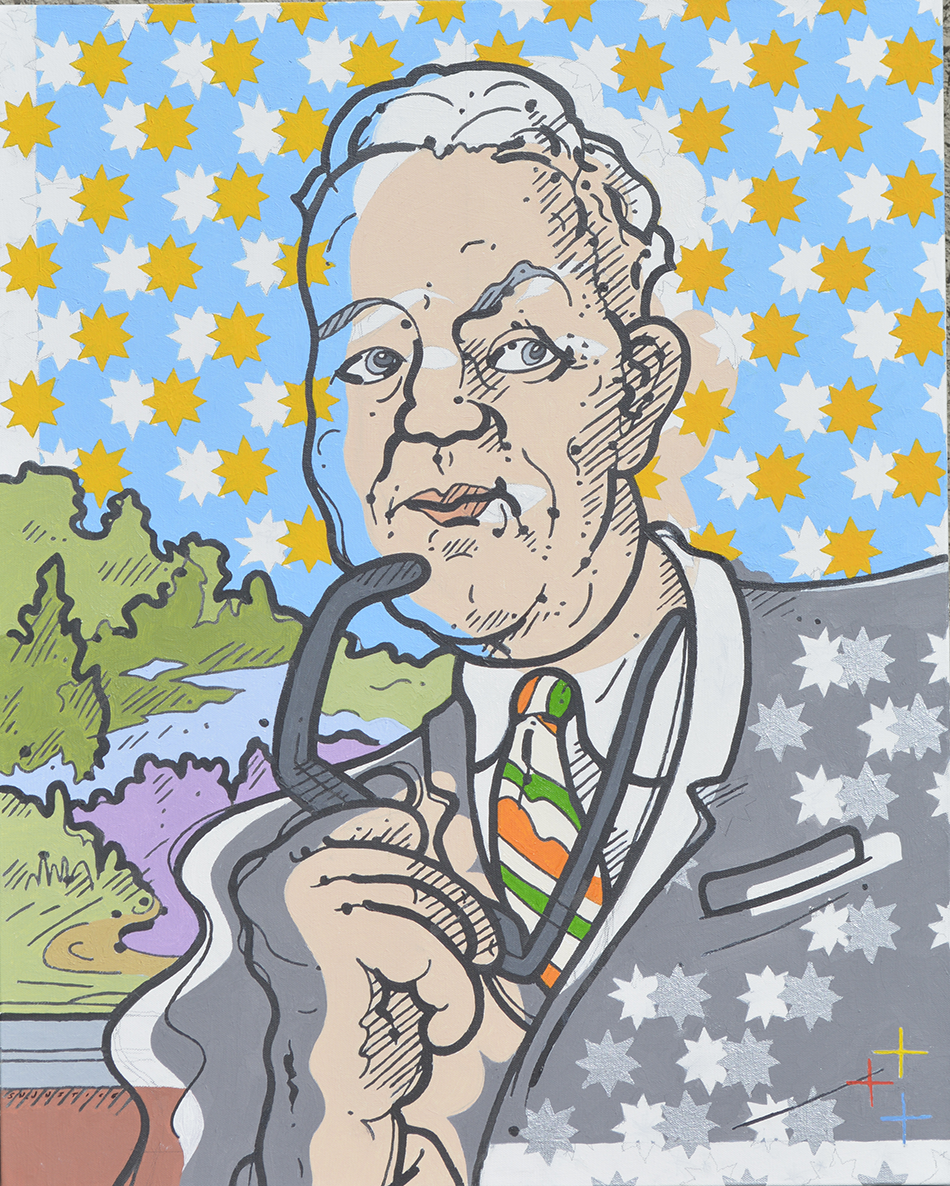
Title: Look to See to Remember: Portrait of Joseph C. Fitzpatrick
Material: Oil on canvas
Size: 30×24
Year: 2019

Look to see to remember.     – Joseph C. Fitzpatrick

With this portrait I am honoring Joseph C. Fitzpatrick, my former art instructor at the Carnegie Institute in Pittsburgh, where I studied in my formative years.  He also taught The Steel City’s very fair-haired son, Andy Warhol.  Fitzpatrick’s training was classical, though he was open-minded enough to identify a good thing when he saw one.  Andy famously went on to have fifteen minutes of fame.

I allow some Andy to leak into this portrait through the Warholic slipping of the color registration, which characterizes many of his own prints.   My fake registration marks have separated into a Steelers logo – I’m sure you noticed that.

I reference Fitzpatrick’s classical background with a classical background, here nicked from the Mona Lisa, but which also calls to mind the Irish or Western Pennsylvaniaish countryside, or even the scenic paintings in Carnegie Museum’s famous animal dioramas, which Firzpatrick had us sketch endlessly with soft 4B pencils on newsprint paper, while sitting on the hard marble floor.

The Renaissance stars (some of them steel) also refer to the Pittsburgh own Renaissance, which Joe, Andy and I participated in.

Fitzpatrick said every artist should have someone standing behind him with a hammer to clobber him when they think the artist is finished.  Many people believe the Mona Lisa was never finished, like so many other projects Leonardo da Vinci took on.  Freud would have had a field day with him.  (What’s that you say?  He did?)  But think of all the hammer blows Leonard avoided receiving.  Which Michelangelo would have willingly delivered.


Frida People: portrait of Frida Kahlo

November 17, 2019

steve-justice-studio-Frida-People

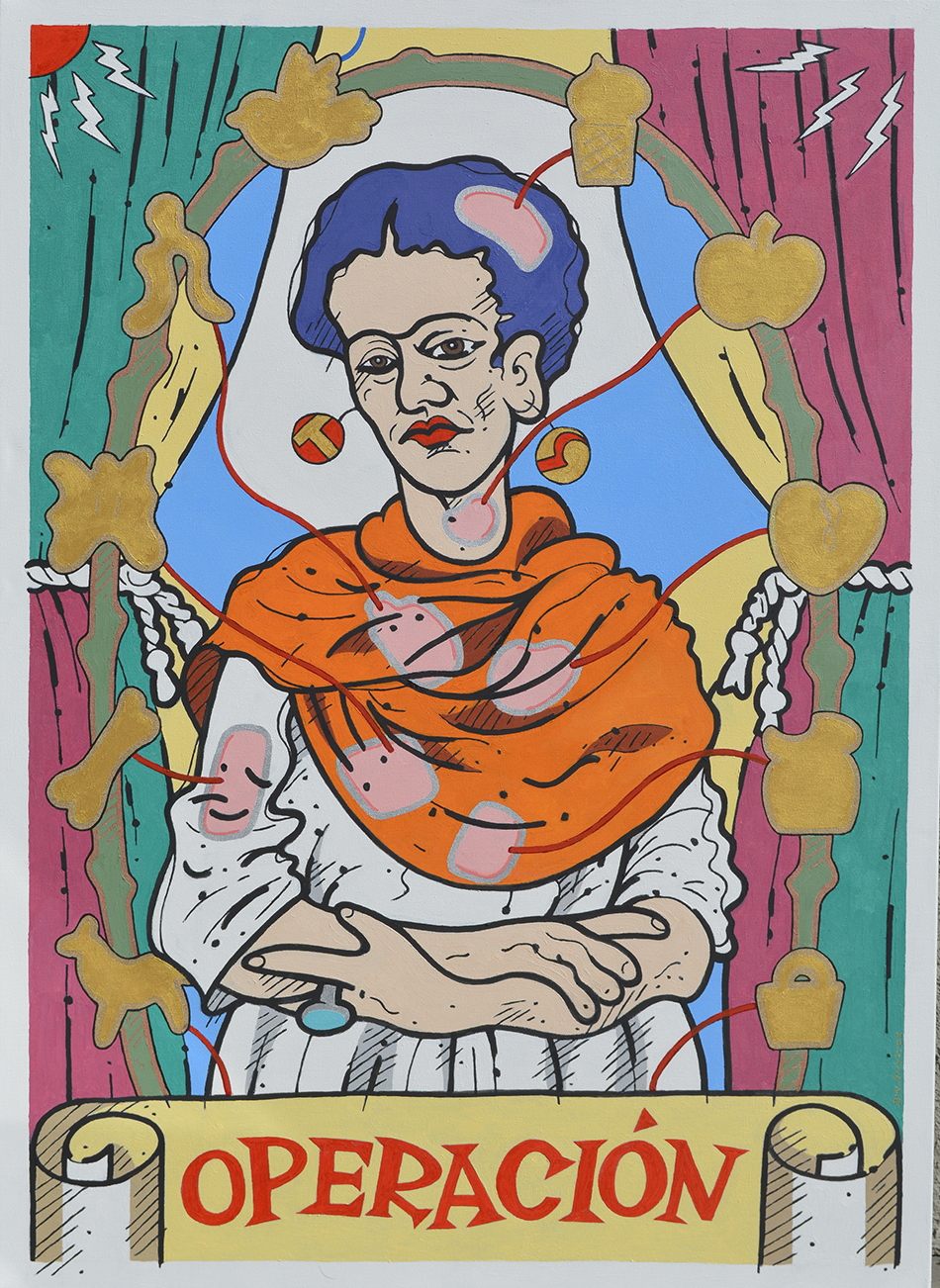
Title: Frida People: portrait of Frida Kahlo
Material: Oil on canvas
Size: 58×42
Year: 2018  SOLD

Pain, pleasure and death are no more than a process for existence.  The revolutionary struggle in this process is a doorway open to intelligence. — Frida Kahlo

Do surrealists make strange people or do strange people make surrealists?  Am I maybe putting the art before the source?  Frida considered herself a realist.  Really.

Frida Kahlo combined Mexican culture, Catholic faith, European surrealism (she was half German), social realist style and memoir to produce magical paintings.  She endured 27 major surgeries as a result of a traffic accident and produced at least that many paintings telling us all about it, many of them with her own guts flying around on red tethers as if spring-loaded.  This morbid sub-genre of hers brought to my mind the classic game introduced in the 1960s, Operation, which was invented by some Cub Scout and is used to train surgeons in Ivy League medical schools.

In this painting the “Operacion” body parts become Milagro charms which replace rosas on a vine surrounding Our Lady of Perpetual Co-payments, who is positioned in a frontal pose and in a format that is proportioned and bordered like a saint card.

Hay preguntas?  (Any questions?)

  • Newer
  • 1
  • 2
  • 3
  • 4
  • 5
  • 6
  • …
  • 12
  • Older

Copyright 2026 Steve Justice Studio | Site design handcrafted by Station Seven