Steve Justice Studio

Art - Design

  • Home
  • Artist Statement
  • Bio and Exhibitions
  • Work
  • Contact

Disraeli’s Fears

February 7, 2015

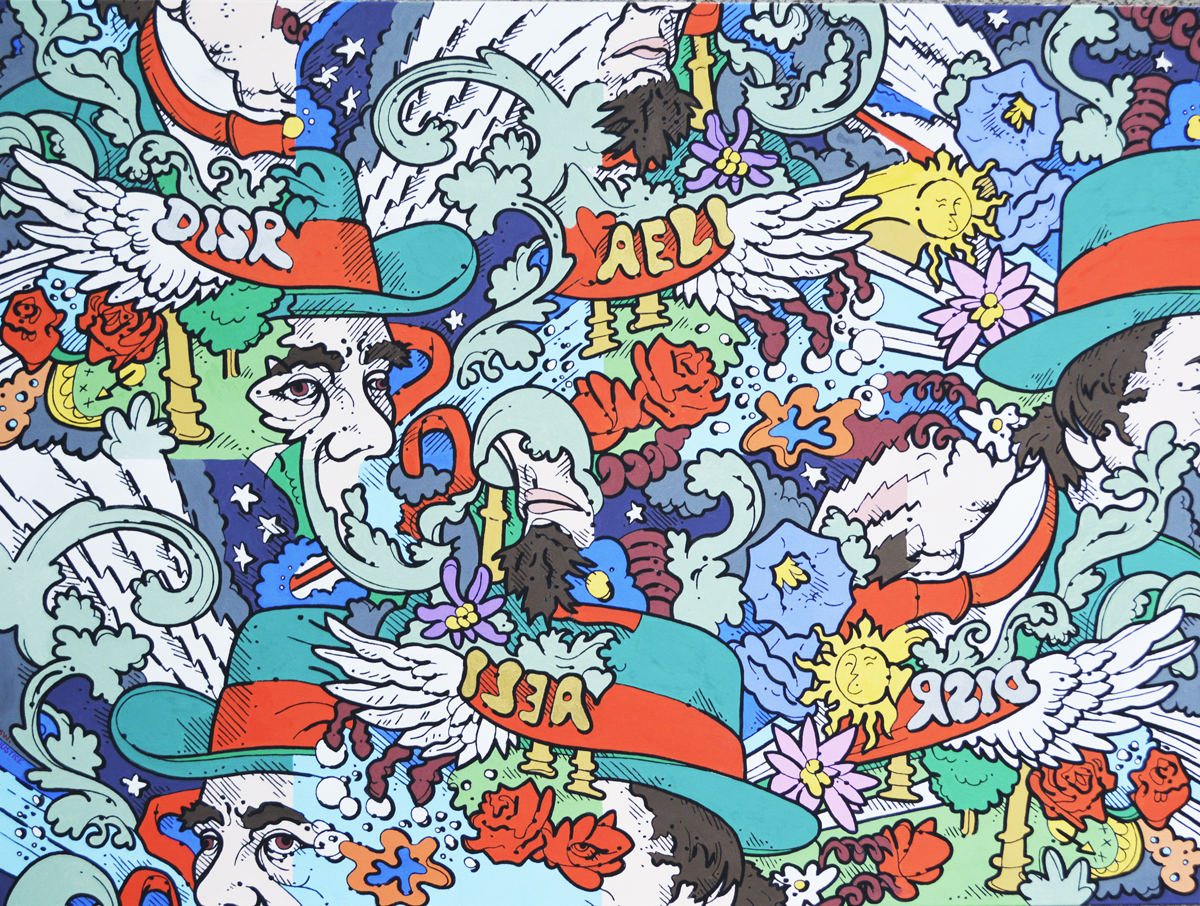
Steve Justice - Painting - Title: Disraeli’s Fears Material: oil on canvas Size: 46x62 Year: 2015 “When I want to read a novel I write one.” -- Benjamin Disraeli

Steve Justice - Painting - Title: Disraeli’s Fears Material: oil on canvas Size: 46x62 Year: 2015 “When I want to read a novel I write one.” -- Benjamin Disraeli
Title: Disraeli’s Fears
Material: oil on canvas
Size: 46×62
Year: 2015

When I want to read a novel, I write one.     – Benjamin Disraeli

Some assembly required.

I have always been excited by masterpieces of 1960s psychedelic art, such as Creams “Disraeli Gears” album cover by Martin Sharp, and I have always been fascinated by politician/writer Benjamin Disraeli himself, a Jew who operated in the highest echelons in Victorian England and was bloody good at what he did, when he wasn’t trying to write another novel.

While drawing one day, I playfully introduced Disraeli’s portrait into a decoration inspired by the Disraeli Gears artwork and played around with the result.  Prompted by my investigations into cheap abstraction, I reversed, doubled, then fractured my image, and then re-assembled it to my liking, and re-wired it.

William Morris patterns complete the scene, influencing my color selection, balance and distribution as I reversed the blaring 1960s colors back into Victorian versions of their compliments, thereby finishing a broken loop of sorts.  Done and dusted!  Cheerio!


Upstate Man

February 7, 2014

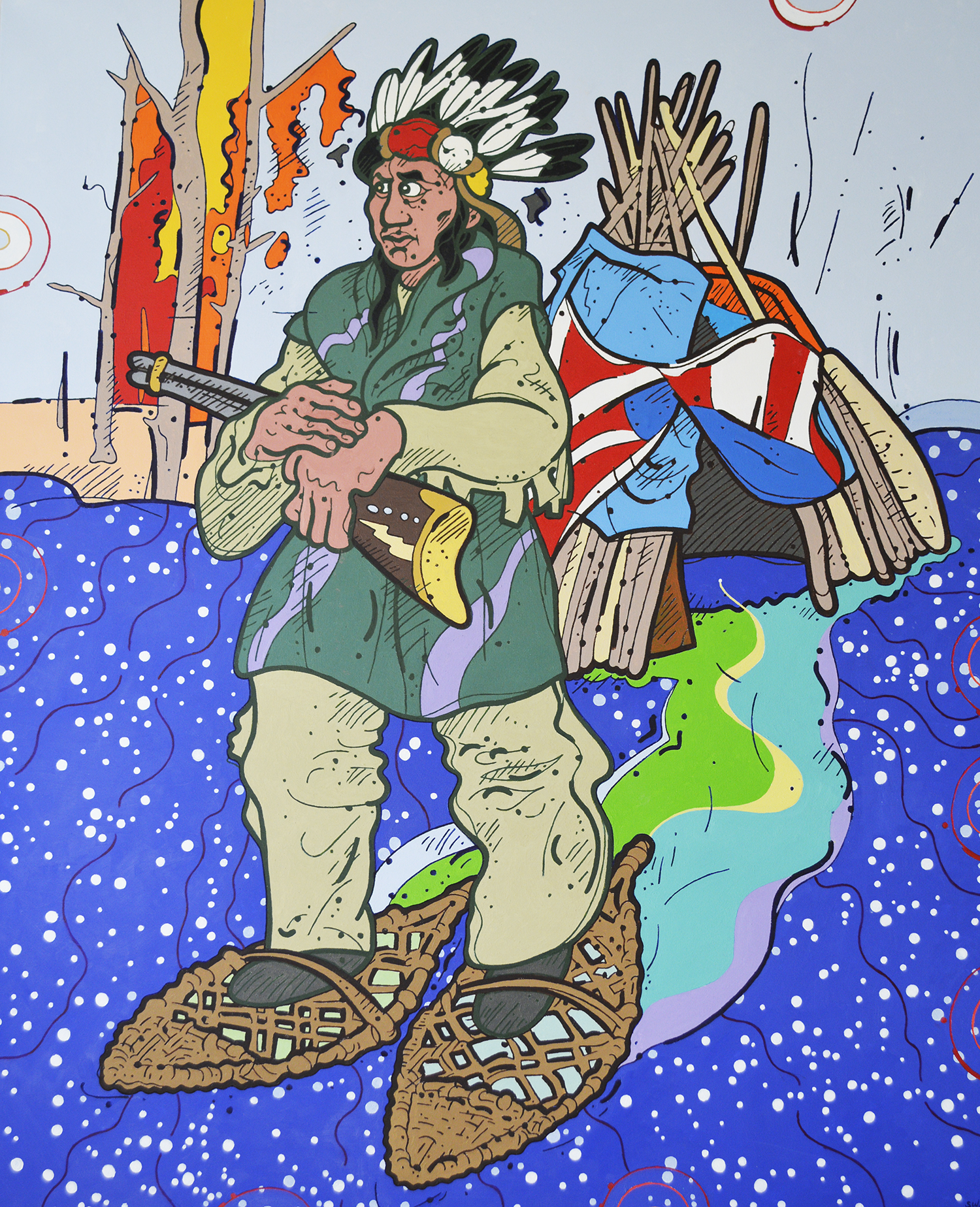
Steve Justice Painting Title: Upstate Man Material: oil on canvas Size: 60x48 Year: 2014 “We do not wish to destroy your religion, or take it from you. We only want to enjoy our own.” -- Handsome Lake This experiment in line and color describes an Ojibwe Indian as a mythical man in an inverted world, so that he shuffles across the sky in snowshoes, creating the Northern Lights in his wake. His lodge is built using blue tarp, surplus traffic signs and even a twisted flag, a sympathetic comment on life on the reservation.

Steve Justice Painting Title: Upstate Man Material: oil on canvas Size: 60x48 Year: 2014 “We do not wish to destroy your religion, or take it from you. We only want to enjoy our own.” -- Handsome Lake This experiment in line and color describes an Ojibwe Indian as a mythical man in an inverted world, so that he shuffles across the sky in snowshoes, creating the Northern Lights in his wake. His lodge is built using blue tarp, surplus traffic signs and even a twisted flag, a sympathetic comment on life on the reservation.

Upstate Man
Material: oil on canvas
Size: 60×48
Year: 2014

Everything the power of the world does is in a circle.  The sky is round, and I have heard that the earth is round like a ball, and so are all the stars.  The wind, with its great power, whirls.  Birds make their nests in circles, for theirs is the same religion as ours.  The sun comes forth and goes down again in a circle.  The moon does the same, and both are round.  Even the seasons form a great circle in their changing, and always come back again to where they were.  The life of man is a circle from childhood to childhood, and so it is in everything where power moves.

— Black Elk


Black Elk was not an Ojibwe, he was Oglala Lakota, but when Black Elk Speaks, you should listen, even if you’ve heard it before.

I’ve seen the Northern Lights twice in my life, but Upstate Man sees it almost every night.  In this inverted creation myth, he creates the Northern Lights as he goes off on a hunt, shuffling through the sky field in his snowshoes.

The edge of the painting started out as an Ojibwe decoration, but it turned all cosmic on me when I enlarged it and became the sun, moon, and planets.  I introduce some rez to the scene with the flag, tarp, rusty sheet metal, and any-DOT sign, all being here recycled as make-shift building materials for his hunting lodge.  The twist in the flag speaks for itself, if you get the gist.

Sometimes simple resonance isn’t enough in art and you need a bigger club.  But it’s all relative, but if you want to learn more about relativity, don’t listen to me.  Talk to a relative.  They haven’t heard from you in months anyhow.


Tell Tchaikovsky the Muse

February 7, 2014

Steve Justice Painting Title: Tell Tchaikovsky the Muse Material: oil on canvas Size: 56x42 Year: 2014 “I sit down at my desk at 9 a.m. and the muse has learned to be on time.” -- Pyotr Ilyich Tchaikovsky Tchaikovsky is always shown in white tie at a premier or some other society event, surrounded by European nobility and czarist Russia. Here he relaxes, maybe on the Caspian, and maybe in his bathrobe, in the colors of the Holiday he articulated for us so well. He died from drinking a tainted glass of water, some say deliberately because of his sexual orientation in an intolerant society.Title: Tell Tchaikovsky the Muse
Material: oil on canvas
Size: 56×42
Year: 2014

“I sit down at my desk at 9 a.m. and the muse has learned to be on time.” — Pyotr Ilyich Tchaikovsky

Tchaikovsky is always shown in white tie at a premier or some other society event, surrounded by European nobility and czarist Russia. Here he relaxes, maybe on the Caspian, and maybe in his bathrobe, in the colors of the Holiday he articulated for us so well. He died from drinking a tainted glass of water, some say deliberately because of his sexual orientation in an intolerant society.

Who’s Afraid of Virginia Woolf

February 7, 2014

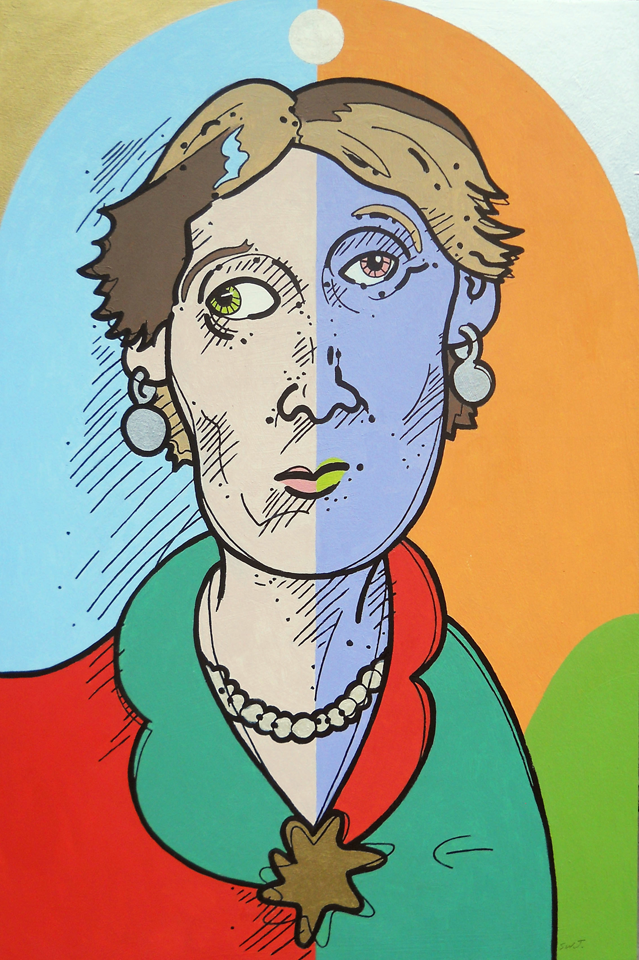
Steve Justice Painting Title: West Virginia Woolfe Material: oil on wood Size: 36x24 Year: 2014 “When I cannot see words curling like rings of smoke around me I am in darkness – I am nothing. I only come into existence when the plumber, or the horse dealer, or whoever it may be, says something which sends me alight. Then how lovely the smoke of my phrases is, rising and falling, flaunting and falling, upon red lobsters and yellow fruit, wreathing them into one beauty.” -- Virginia Woolf If Virginia Woolf looks depressed in photos, it’s because she frequently was. Privilege, talent and education make no difference when Churchill’s so-called “black dog” is on your trail. This painting’s split of positive and negative colors attempts to explain this circumstance and how Virginia produced such timeless brilliance in spite of it. The hillocks behind her are nothing but a cheap gimmick meant to justify this painting’s clever but misleading title.

Steve Justice Painting Title: West Virginia Woolfe Material: oil on wood Size: 36x24 Year: 2014 “When I cannot see words curling like rings of smoke around me I am in darkness – I am nothing. I only come into existence when the plumber, or the horse dealer, or whoever it may be, says something which sends me alight. Then how lovely the smoke of my phrases is, rising and falling, flaunting and falling, upon red lobsters and yellow fruit, wreathing them into one beauty.” -- Virginia Woolf If Virginia Woolf looks depressed in photos, it’s because she frequently was. Privilege, talent and education make no difference when Churchill’s so-called “black dog” is on your trail. This painting’s split of positive and negative colors attempts to explain this circumstance and how Virginia produced such timeless brilliance in spite of it. The hillocks behind her are nothing but a cheap gimmick meant to justify this painting’s clever but misleading title. Title: West Virginia Woolfe
Material: oil on wood
Size: 36×24
Year: 2014

When I cannot see words curling like rings of smoke around me I am in darkness – I am nothing.  I only come into existence when the plumber, or the horse dealer, or whoever it may be, says something which sends me alight.  Then how lovely the smoke of my phrases is, rising and falling, flaunting and falling, upon red lobsters and yellow fruit, wreathing them into one beauty.     – Virginia Woolf

Virginia Woolf looks depressed in most photos, because she frequently was.  Never hold that against anyone.  Privilege, talent and education don’t mean a thing when the Black Dog is on your trail.  The good news is, a bi-polar doesn’t have to go far for a second opinion, if I’m doing it right.   Tell me if I’m not.  Bi-polar creative artists are legion, and stigma is neither your creation nor mine, so there is no reason to thoughtlessly buy into it, so let’s don’t and say we didn’t.

This painting’s split of positive and negative colors and Virginia’s conflicted countenance serve to describe the circumstance of her inner state and how she produced (or co-produced) such timeless brilliance in spite of it.  She is one of many reasons I’m so interested in flawed geniuses and broken heroes.  Sometimes your problems are the seed of your potential, and since no-one is perfect, with proper management, that presents an herbiverse of possibilities.  But keep a leash on that dog – Virginia’s ran off and drowned.

 The green hillock behind her left shoulder serves only to fill space, but it reminded me of the hills of West Virginia, the birthplace of my father’s father (Milton – the town, not his name), hence my working title “West Virginia Woolf”, which in the end was too corny to make the cut.

Using what you have learned:  In the space remaining, compare and contrast Stignatism, Stigmatism, and Kruschev’s Anti-smegmatarianist policies in Central Asia.  Use examples.

Fender Bender: portrait of Leo Fender

February 7, 2014

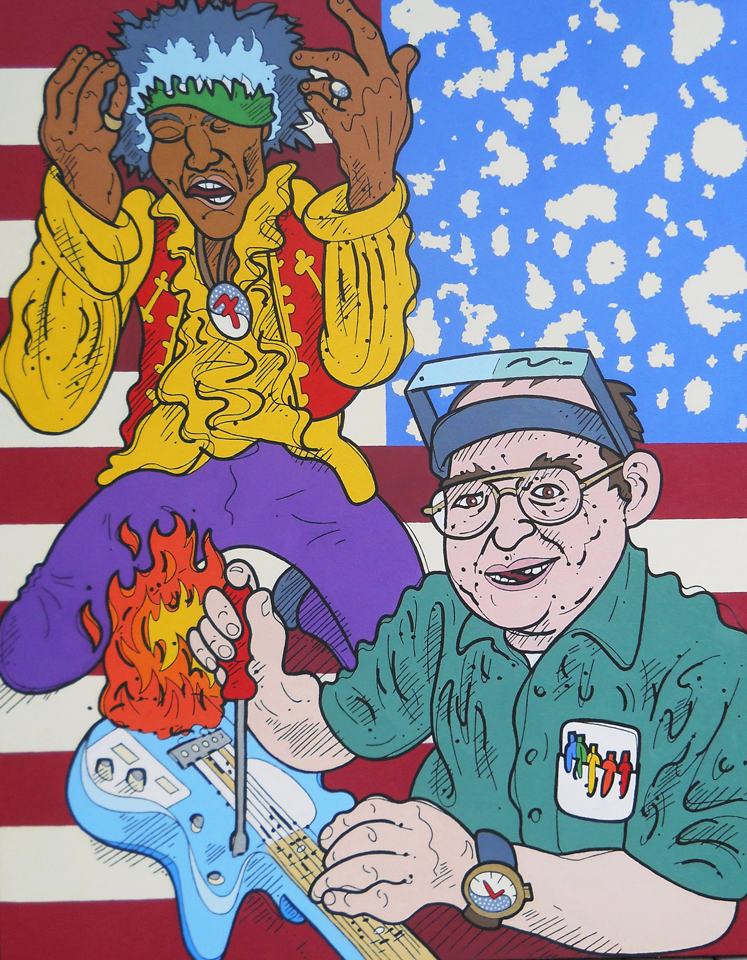
Steve Justice Painting Title: Fender Bender: portrait of Leo Fender 7 Material: oil on canvas Size: 60x48 Year: 2014 “Music is going to break the way because music is a spiritual thing of its own. You can’t just cut out the perfect wave and take it home with you.” -- Jimi Hendrix In “Fender Bender”, I make Jimi Hendrix a supporting character in his own painting by focusing on his instrument rather than his athleticism in using it. Hendrix’s guitar, which he used to create, but then would famously destroy, was designed and built by Leo Fender, a simple working man with an unlikely interest in loud electric musical instruments. With a nod toward both patriotic and counter cultures in the late 1960s, I paint a semblance of an American flag into the background, rendered here in political convention television colors. The guitar-burning is Monterey, the flag is Woodstock, and those two concerts roughly bracketed Hendrix’s very brief time in the limelight. The 50 stars are actual stars seen in the heavens.

Steve Justice Painting Title: Fender Bender: portrait of Leo Fender 7 Material: oil on canvas Size: 60x48 Year: 2014 “Music is going to break the way because music is a spiritual thing of its own. You can’t just cut out the perfect wave and take it home with you.” -- Jimi Hendrix In “Fender Bender”, I make Jimi Hendrix a supporting character in his own painting by focusing on his instrument rather than his athleticism in using it. Hendrix’s guitar, which he used to create, but then would famously destroy, was designed and built by Leo Fender, a simple working man with an unlikely interest in loud electric musical instruments. With a nod toward both patriotic and counter cultures in the late 1960s, I paint a semblance of an American flag into the background, rendered here in political convention television colors. The guitar-burning is Monterey, the flag is Woodstock, and those two concerts roughly bracketed Hendrix’s very brief time in the limelight. The 50 stars are actual stars seen in the heavens.Title: Fender Bender: portrait of Leo Fender
Material: oil on canvas
Size: 60×48
Year: 2014

Music is going to break the way because music is a spiritual thing of its own.  You can’t just cut out the perfect wave and take it home with you.    

— Jimi Hendrix

In “Fender Bender”, Jimi Hendrix becomes a supporting character in his own painting by being upstaged by his instrument, which in turn is upstaged by its designer and builder, Leo Fender, a simple radio repairman who didn’t even like loud music.  He lost his hearing in one ear while trying to fix an amplifier for surf-guitar legend Dick Dale.  Dick Dale strung his guitar by losing the B and E strings, moving the other 4 up, and adding D and G bass strings.  His strings were so tight that he broke a lot of picks when he played.  He had a pick dispenser mounted to his guitar so that he could toss his broken picks into the crown and replace them without missing a beat.

With a nod toward 60s counter-culture and the blue-collar patriotism of the times, I painted into the background of Fender Bender a semblance of an American flag (with 50 stars – count ‘em and weep), shown here in the TV-friendly off-shades of red, white and blue that are used in televised political conventions.  Jimi Hendrix’s guitar-burning occurred at the Monterey Pop Festival, the flag is Hendrix’s “Star Spangled Banner” at Woodstock, and those two concerts roughly bracketed Hendrix’s few years of fame.

Where’s the next Hendrix?  Where’s the next Jesus?  They’re probably already here, so keep your eyes, ears and mind open.  But remember this: a fire cannot burn the same way twice, because fires don’t burn twice.

O’Keefe Magic

February 7, 2014

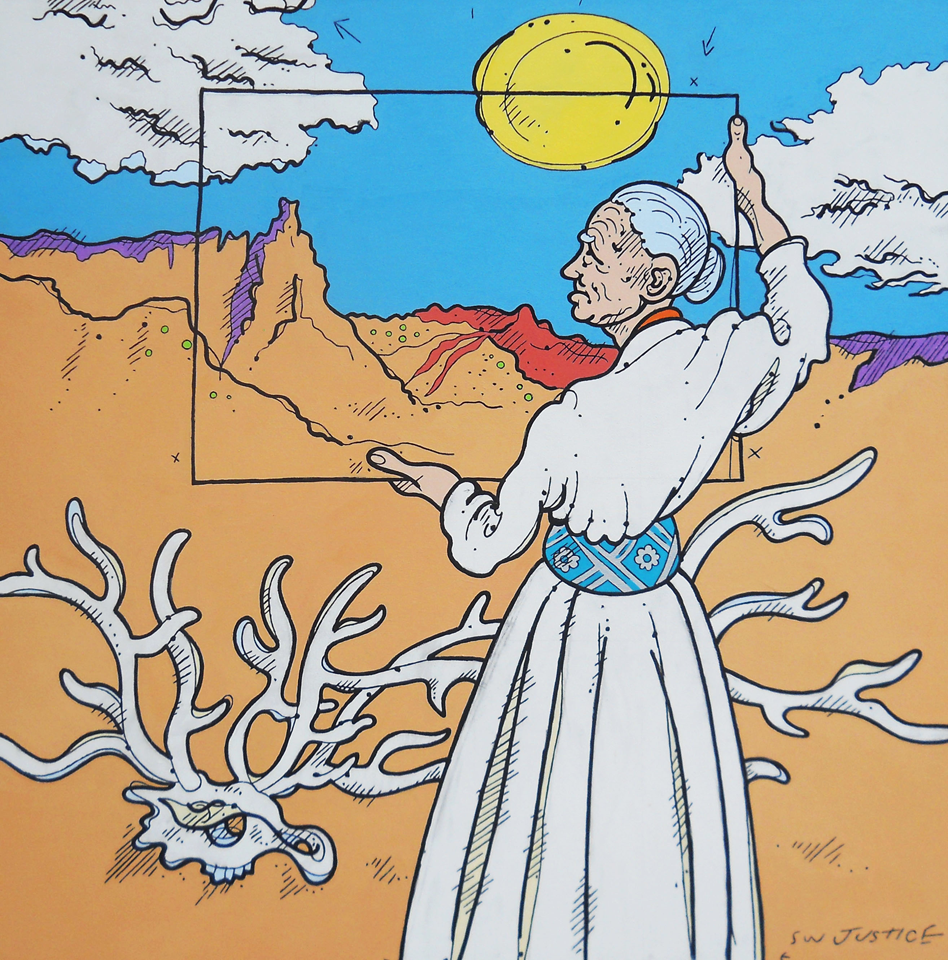
Steve Justice Painting Title: O’Keefe Magic Material: oil on canvas Size: 48x48 Year: 2014 I long ago came to the conclusion that even if I could put down accurately the thing I saw and enjoyed, it would not give the observer the kind of feeling it gave me. I had to create an equivalent for what I felt about what I was looking for – not copy it. – Georgia O’Keefe I expected the desert to be a drab, barren environment, but I found it to be a place surrounded with wonder, where the art tracks down the artist rather than the other way around. Georgia O’Keefe didn’t have to go far for inspiration. She’s been accused of painting female genitalia into her work, so here I make a play at balancing the books.

Steve Justice Painting Title: O’Keefe Magic Material: oil on canvas Size: 48x48 Year: 2014 I long ago came to the conclusion that even if I could put down accurately the thing I saw and enjoyed, it would not give the observer the kind of feeling it gave me. I had to create an equivalent for what I felt about what I was looking for – not copy it. – Georgia O’Keefe I expected the desert to be a drab, barren environment, but I found it to be a place surrounded with wonder, where the art tracks down the artist rather than the other way around. Georgia O’Keefe didn’t have to go far for inspiration. She’s been accused of painting female genitalia into her work, so here I make a play at balancing the books. Title: O’Keefe Magic
Material: oil on canvas
Size: 48×48
Year: 2014

I long ago came to the conclusion that even if I could put down accurately the thing I saw and enjoyed, it would not give the observer the kind of feeling it gave me.  I had to create an equivalent for what I felt about what I was looking for – not copy it.     – Georgia O’Keefe

More and more I believe less is more less and less.  I expected the New Mexico desert to be a drab, barren moonscape, but I found it to be a place of wonder, where beauty tracks down the artist rather than the other way around.  Nothing is lacking in the desert.  There is as much or more to experience in an acre of Mojave as there is in an acre of Manhattan, and you can quote me, boys!  Georgia O’Keefe didn’t have to wait long or go far for her inspiration in her adopted desert.

The skull is a little bit more than this artist’s getting silly with one of Georgia’s recurring motifs.  The antlers penetrating her pelvis is also a male’s response to what are suspected as being other, suggestive themes in her own work.  Freud would have been proud of me.  Or jealous.  Or conflicted.

Start with what you know.  Create convergences.  Don’t wait for them.   Near-convergences are the next best thing.   Any questions?  Any answers?  Just give me a call – I’m in the phone book.

Play Firebird!: portrait of Igor Stravinsky

February 7, 2014

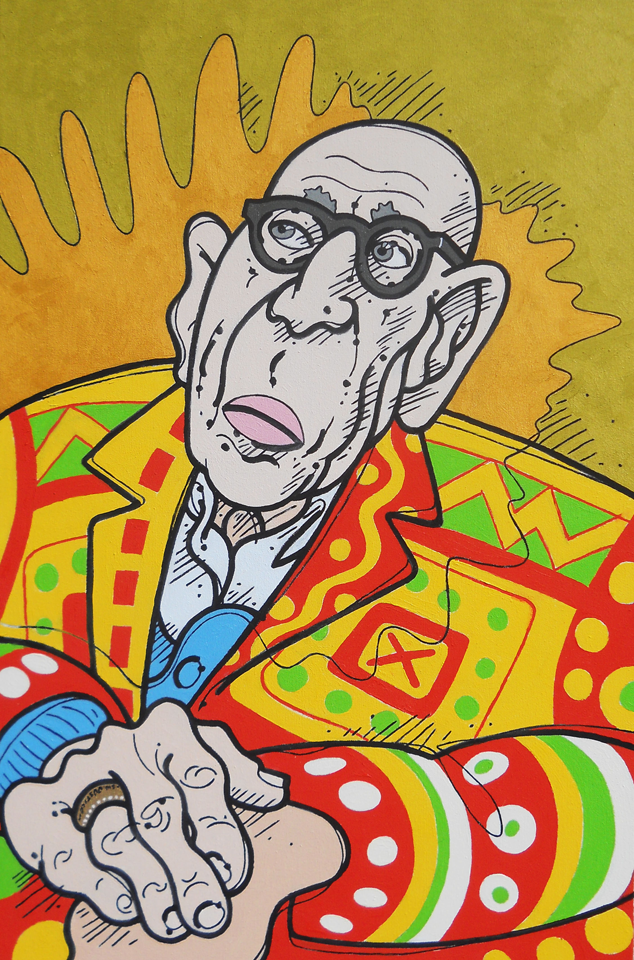
Steve Justice Painting Title: To the Right of Spring: portrait of Igor Stravinsky Material: oil on canvas Size: 36x24 Year: 2014 “I have learned throughout my life as a composer chiefly through my mistakes and false assumptions, not by my exposure to founts of wisdom and knowledge.” -- Igor Stravinsky I have seen these gold-green and gold-orange colors while meditating, and I suspect that these visuals have something to do with fertility and creative inspiration, so I use them here. On Igor’s jacket I employ the same pattern that appeared on the actual Rite of Spring dancers’ costumes.

Steve Justice Painting Title: To the Right of Spring: portrait of Igor Stravinsky Material: oil on canvas Size: 36x24 Year: 2014 “I have learned throughout my life as a composer chiefly through my mistakes and false assumptions, not by my exposure to founts of wisdom and knowledge.” -- Igor Stravinsky I have seen these gold-green and gold-orange colors while meditating, and I suspect that these visuals have something to do with fertility and creative inspiration, so I use them here. On Igor’s jacket I employ the same pattern that appeared on the actual Rite of Spring dancers’ costumes.Title: Play Firebird!: portrait of Igor Stravinsky
Material: oil on canvas
Size: 36×24
Year: 2014


I have learned throughout my life as a composer chiefly through my mistakes and false assumptions, not by my exposure to founts of wisdom and knowledge.     – Igor Stravinsky

Igor Stravinsky almost got lynched by audiences when his symphonic works were premiered, they were so odd.  But original, and good, and now classic.

I have seen these shades of green-gold while meditating, and I sense these visuals have something to do with fertility and creative inspiration, so I use them here.  Igor’s jacket bears the same pattern that appeared on actual

Rite of Spring dancers’ costumes.  The dancers were his instruments too, along with the orchestra, a detail that is lost on many music lovers.

Stravinsky has taught me, a successful artist can turn fans’ anger into disappointment, which is always easier to shovel.


Physics is Phun: portrait of Niels Bohr

February 7, 2014

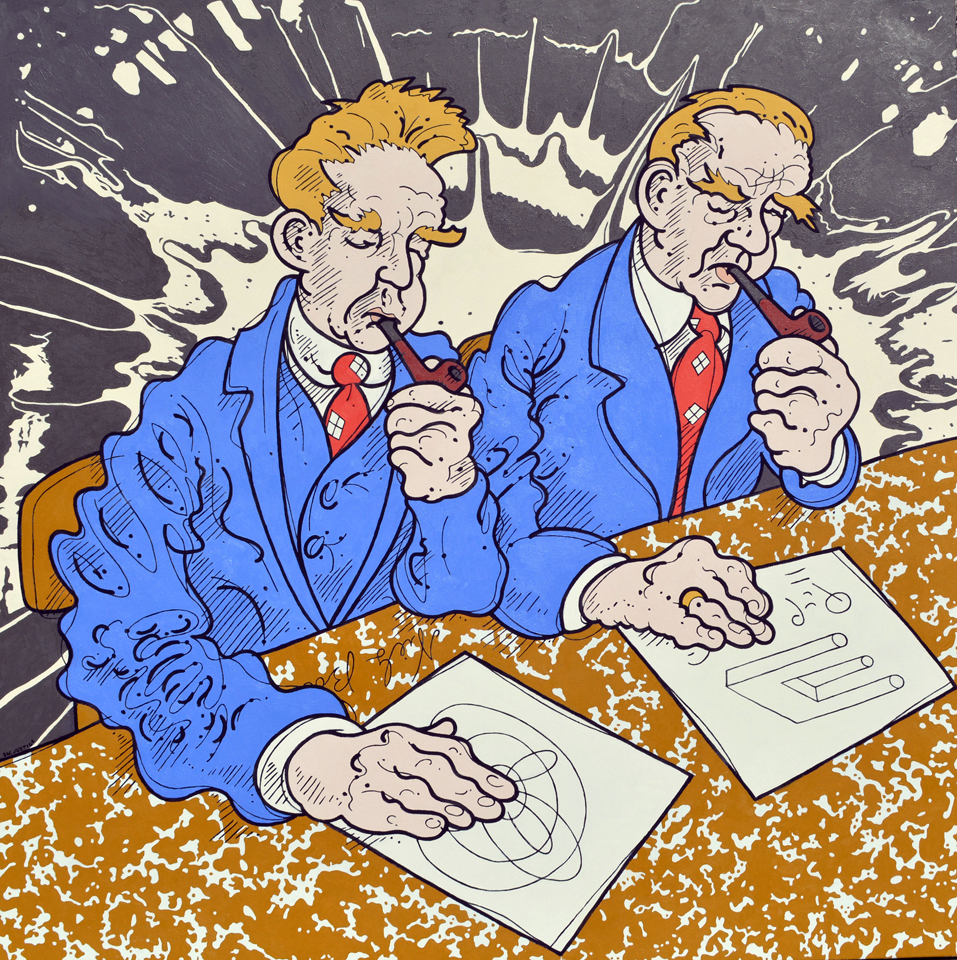
Steve Justice Painting Title: Physics is Phun: portrait of Niels Bohr Material: oil on canvas Size: 60x60 Year: 2014 “The poet, too, is not so concerned with describing facts as with creating images.” -- Niels Bohr At Princeton there once were three offices in a row, occupied by the faculty members, Albert Einstein, Robert Oppenheimer and Niels Bohr. “Physics is Phun”, which was one of my physics teacher’s oft-repeated catch-phrases, is about high school physics and the oaken, blackboard darkness that served as its classroom. Niels Bohr was revered there, for his genius and opinions, as a young man and as an elder in his field. Using Spin-Art as a sketch tool, I created what appears to be a radiating splatter of chalk on a blackboard, as if that day’s lesson was on centrifugal force. A square format therefore made the most sense. The furniture is dappled with light as if from trees outside, with a composition book pattern.

Steve Justice Painting Title: Physics is Phun: portrait of Niels Bohr Material: oil on canvas Size: 60x60 Year: 2014 “The poet, too, is not so concerned with describing facts as with creating images.” -- Niels Bohr At Princeton there once were three offices in a row, occupied by the faculty members, Albert Einstein, Robert Oppenheimer and Niels Bohr. “Physics is Phun”, which was one of my physics teacher’s oft-repeated catch-phrases, is about high school physics and the oaken, blackboard darkness that served as its classroom. Niels Bohr was revered there, for his genius and opinions, as a young man and as an elder in his field. Using Spin-Art as a sketch tool, I created what appears to be a radiating splatter of chalk on a blackboard, as if that day’s lesson was on centrifugal force. A square format therefore made the most sense. The furniture is dappled with light as if from trees outside, with a composition book pattern.Title: Physics is Phun: portrait of Niels Bohr
Material: oil on canvas
Size: 60×60
Year: 2014

The poet, too, is not so concerned with describing facts as with describing images.     – Niels Bohr

In high school Honors Physics class, I challenged myself to make it through the entire course without using either a calculator, which didn’t exist yet, or that weapon which nerds open-carried for self-defense, the slide-rule.  This turned out to be one of my least successful physics experiments, and, not unpredictably, my grade dropped at a rate of 32 feet per second squared.

But it wasn’t such a crazy idea in principle.  After all, the calculator was invented without the use of a calculator and the slide rule was invented without the use of a slide rule.  I managed to save myself from complete failure, on the theoretical side, thank you, by reading and reporting on the works of great thinkers such as Einstein, Feynman, Fermi, Bohrs, Planck, the Professor and Mary Ann.

My painting “Physics is Phun” (which was one of my physics teacher’s catch-phrases) turned out being about high school physics and the oaken, blackboard dankness that served as its classroom.  This painting’s subject, Niels Bohr, was spoken there, revered for his genius, opinions, and celebrity, book-ended by his deeds as a young physicist and his words as an elder.

I arrived at this transgenerational time leak after doodling around with Bohrs’ plural-sounding surname “Niels”.   Using an old Spin-art project of my daughter’s as a model, I created what appears to be a radiating splatter of chalk on the chalkboard, as if that day’s lesson was about centrifugal force and the teacher had spun the board.

Our classroom was hall-locked, meaning it had no windows through which to lose myself, so I here borrow one from the art room.  The oak furniture is subsequently dappled with light as if filtered through trees outside, creating the same pattern one also finds on a student’s composition book.


Expecting to Fly: portrait of Neil Young

February 7, 2014

Steve Justice Painting Title: The Color of Smoke: portrait of Neil Young Material: oil on canvas Size: 54x54 Year: 2014 “Sometimes when I’m writing a song I can feel there’s other things in me that are not me. That’s why I hesitate to edit my songs. If it’s something I have to think about and contrive, work at, it’s usually not that good. My best work just comes through me. A lot of times what comes through me is coming from somewhere else … I think we’re all vehicles for each other.” -- Neil Young Neil Young takes leave of himself when he charges off on a guitar solo. In this painting, I resisted the cliche of depicting a guitar hero with abstract splashes, smears and slashes. I instead chose the arcane autobiographical and anthroposophical details and tendencies that Neil himself might use, including here a classic Americana decorative motif (cube quilts, Whitehall glass etc), in this case colored as sky, sepia and psychedelia. The title comes from a note I made to myself on one of my color studies.

Steve Justice Painting Title: The Color of Smoke: portrait of Neil Young Material: oil on canvas Size: 54x54 Year: 2014 “Sometimes when I’m writing a song I can feel there’s other things in me that are not me. That’s why I hesitate to edit my songs. If it’s something I have to think about and contrive, work at, it’s usually not that good. My best work just comes through me. A lot of times what comes through me is coming from somewhere else … I think we’re all vehicles for each other.” -- Neil Young Neil Young takes leave of himself when he charges off on a guitar solo. In this painting, I resisted the cliche of depicting a guitar hero with abstract splashes, smears and slashes. I instead chose the arcane autobiographical and anthroposophical details and tendencies that Neil himself might use, including here a classic Americana decorative motif (cube quilts, Whitehall glass etc), in this case colored as sky, sepia and psychedelia. The title comes from a note I made to myself on one of my color studies.

Title: Expeting to Fly: Portrait of Neil Young
Material: oil on canvas
Size: 54×54
Year: 2014

Sometimes when I’m writing a song I can feel there’s other things in me that are not me.  That’s why I hesitate to edit my songs.  If it’s something I have to think about and contrive, work at, it’s usually not that good.  My best work just comes through me.  A lot of times what comes through me is coming from somewhere else.     – Neil Young

The proficient, prolific and precocious Neil Young began his musical career in the 1960s when he was a teenager, and has come to epitomize that decade’s lost incense.  The loudest sound I’ve ever heard suggested itself when I was concussed by Neil Young and his band Crazy Horse in a small concrete bunker of a venue in Columbus, Ohio, as I sat a mere eight rows away from the virtuoso.  This painting began with that faraway look in Neil’s eyes when he takes leave of himself, turns all trebly and starts smearing a guitar solo all over the place.  It’s a beautiful mess, but I know he’s not there.  I can see it in his eyes — he’s somewhere else.  Down by the river, or lying in a burned-out basement.  Or maybe on the Cripple Creek Ferry, butting through the overhanging trees.  Or at Sugar Mountain, with the barkers and the colored balloons.  Or lying on his back in the schoolyard.  Don’t be denied.

In this painting I resisted the cliché of depicting a guitar hero with abstract, slashy and splashy brush strokes that bring to mind what I imagine Leroy Neiman’s Calvin Kleins look like.  Instead, I apply the arcane auto-biographical and anthroposophical details and tendencies that Neil himself might use, including, here, a classic Americana decorative motif in the background (cube quilts, Whitehall glass & c.), in this case tinted as the Saskachawanian sky, old-time sepia and psychedelia.  The various bird symbols derive from his life and art.  The primitive bird imposed over the Woodstock dove is from an ancient petroglyph I saw near Jackson, Ohio.  I’m pretty sure its copyright has expired by now.


Blue Bob #12 & #35

February 7, 2013

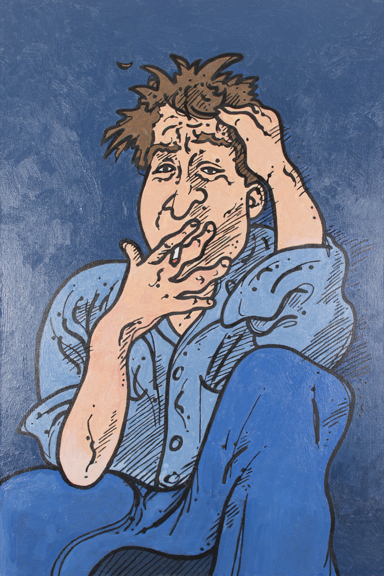
Steve Justice Painting Title: Blue Bob #12 & 35 Material: oil on canvas Size: 30x20 2013 “The songs were easy to write and seemed to float downstream with the current. It’s not like they’d been faint or far away — they were right there in my face, but if you’d look too steady at them, they’d be gone.” -- Bob Dylan

Steve Justice Painting Title: Blue Bob #12 & 35 Material: oil on canvas Size: 30x20 2013 “The songs were easy to write and seemed to float downstream with the current. It’s not like they’d been faint or far away — they were right there in my face, but if you’d look too steady at them, they’d be gone.” -- Bob Dylan Title: Blue Bob #12 & 35
Material: oil on canvas
Size: 30×20
2013     SOLD


Creativity has much to do with experience, observation and imagination, and if any one of those key elements is missing, it doesn’t work.

— Bob Dylan

How does it feel?

This title is a very thinly veiled reference to Dylan’s song, “Rainy Day Woman #12 & #35, aka the “Everybody must get stoned” song.  I don’t know what he’s talking about.  Stoning seems so Biblical in this day and age, but maybe it was the punishment for speaking with your mouth full in the mining town of Hibbings, Minnesota, where Dylan grew up.

Potato mining had at one time so overtaken the town of Hibbings that the entire town had to be moved two miles upwind.  True story.  From Hibbings, the potatoes were transported by rail to the big lake they call Gitche Gumee, and loaded onto long freighters like the Edmund Fitzgerald.  But that’s another song by another folk singer.

  • Newer
  • 1
  • …
  • 7
  • 8
  • 9
  • 10
  • 11
  • …
  • 14
  • Older

Copyright 2025 Steve Justice Studio | Site design handcrafted by Station Seven