Steve Justice Studio

Art - Design

  • Home
  • Artist Statement
  • Bio and Exhibitions
  • Work
  • Contact

The Piano Lesson

February 7, 2015

Steve Justice Studio Title: The Piano Lesson Material: oil on canvas Size: 48x60 Year: 2015 “Our party has so closely followed the growth of all musical life in our country. I have been aware of that close attention throughout my creative life.” -- Dmitri Shostakovich This double portrait explores the staying power and genius of the composer Dmitri Shostakovich who, by wits and wile, negotiated the tightrope between self-expression and personal doom in Stalin’s Soviet Union. The “piano lesson” is a common in the history of painting. I here introduce the character of the meddling Stalin, accompanied by the ghost of Marx and the words of Lennon, “War is over!”, in the style of Soviet poster art.

Steve Justice Studio Title: The Piano Lesson Material: oil on canvas Size: 48x60 Year: 2015 “Our party has so closely followed the growth of all musical life in our country. I have been aware of that close attention throughout my creative life.” -- Dmitri Shostakovich This double portrait explores the staying power and genius of the composer Dmitri Shostakovich who, by wits and wile, negotiated the tightrope between self-expression and personal doom in Stalin’s Soviet Union. The “piano lesson” is a common in the history of painting. I here introduce the character of the meddling Stalin, accompanied by the ghost of Marx and the words of Lennon, “War is over!”, in the style of Soviet poster art. Title: The Piano Lesson
Material: oil on canvas
Size: 48×60
Year: 2015

Our party has so closely followed the growth of all musical life in our country.  I have been aware of that close attention throughout my creative life.     – Dmitri Shostakovich

When Josef Stalin was in his teens, he and some friends (I guess they weren’t comrades yet) spotted a calf stranded by flood water on a small piece of island in the river.   There was only one thing for a man to do, Joe decided, so he removed his shirt and shoes, bravely swam through the current out to the calf, then … he broke the calf’s legs and swam back.  Ever the showman, he knew if you want to make a Hamlet you’ve got to break some legs.

This double portrait explores the stamina and genius of the Russian composer, Dmitri Shostakovich, who by charm, wits and wile, negotiated the tightrope between self-expression and personal disaster in Stalin’s Soviet Union.   ‘The Piano Lesson’ as a subject is common in art history, with the punchline often involving unwelcome advances on the part of the Senator – I mean, piano teacher.  In Soviet poster style, I here introduce the character of the meddling Stalin, accompanied by the smoky ghost of Marx and the words of Lennon (in Cyrillic), “WAR IS OVER!”
Erniology: portrait of Ernie Bushmiller

February 7, 2015

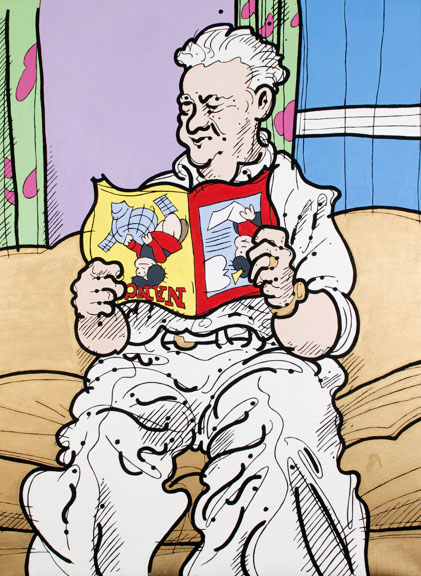
Steve Justice Painting Title: Erniology: portrait of Ernie Bushmiller SOLD Material: oil on canvas Size: 52x38 Year: 2015 “Being a cartoonist is like having a bear by the tail. You can never let go.” -- Ernie Bushmiller In “Erniology”, the long-time creator of the comic “Nancy” is honored as a holy fool, sitting on his throne, while mayhem ensues. His corny comics were easy to find, easy to read and easy to understand, even when he would change things up with some unexpected imaginative stretches.

Steve Justice Painting Title: Erniology: portrait of Ernie Bushmiller SOLD Material: oil on canvas Size: 52x38 Year: 2015 “Being a cartoonist is like having a bear by the tail. You can never let go.” -- Ernie Bushmiller In “Erniology”, the long-time creator of the comic “Nancy” is honored as a holy fool, sitting on his throne, while mayhem ensues. His corny comics were easy to find, easy to read and easy to understand, even when he would change things up with some unexpected imaginative stretches.Title: Erniology: Portrait of Ernie Bushmiller
Material: oil on canvas
Size: 52×38
Year: 2015 SOLD

If a kid slips on a banana peel in Norway he still falls down.    — Ernie Bushmiller

In “Erniology”, the creator of the comic strip “Nancy” for over 50 years, Ernie Bushmiller, is honored as a holy fool sitting on his throne, while mayhem of his own making ensues.  His koan-like comics (he wrote and drew about 14,000 of them) were easy to find and easy to read, but not always easy to comprehend.

I always figured Sluggo to be German-Irish and from the Bronx, because Ernie was, plus Sluggo wore patched clothing and had an extraordinarily poor awareness of grammar and syntax.  But Nancy would need to consult Ancestry.com to explain that hair of hers.


O: portrait of Oscar Wilde

February 7, 2015

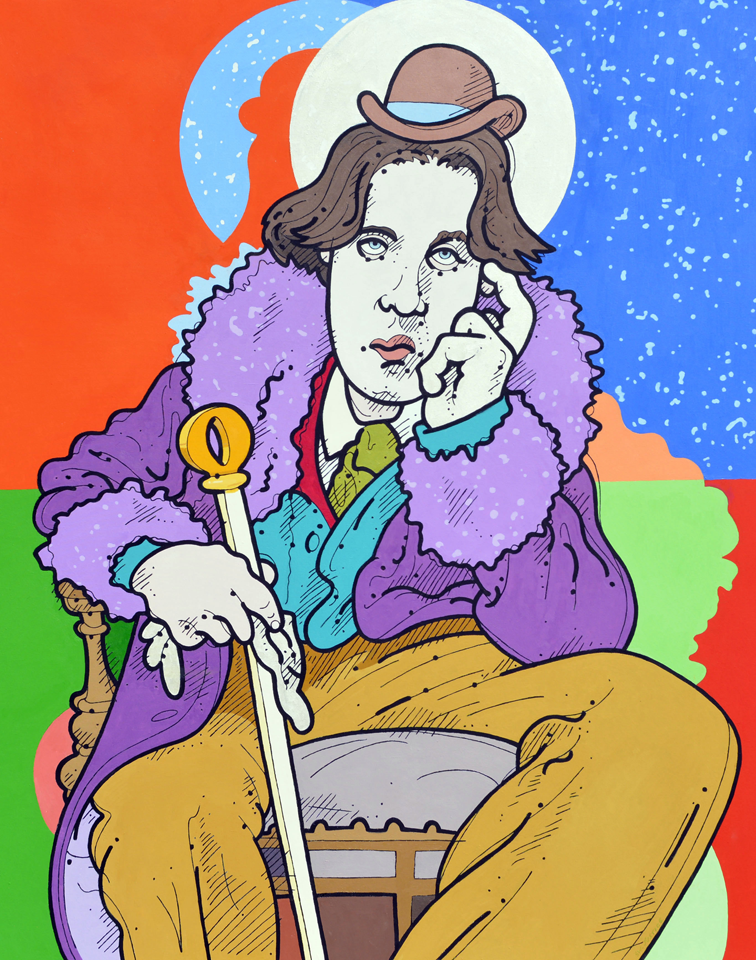
Steve Justice Painting Title: O: portrait of Oscar Wilde Material: oil on canvas Size: 60x48 Year: 2015 “The past is what man should not have been. The present is what man ought not to be. The future is what artists are.” – Oscar Wilde Oscar Wilde lectured throughout the U.S. for an entire year, perhaps making of himself the world’s first celebrity, to support a touring show he wrote starring a character comically based on himself. My usual, iconesque centering of the chakras anchors the subject and allows me to take more liberties with symmetry. The color and fashion of his clothing was as respectfully researched by me as it would have been chosen by him, except for the little clay hat he must have bought when he visited New Mexico.

Steve Justice Painting Title: O: portrait of Oscar Wilde Material: oil on canvas Size: 60x48 Year: 2015 “The past is what man should not have been. The present is what man ought not to be. The future is what artists are.” – Oscar Wilde Oscar Wilde lectured throughout the U.S. for an entire year, perhaps making of himself the world’s first celebrity, to support a touring show he wrote starring a character comically based on himself. My usual, iconesque centering of the chakras anchors the subject and allows me to take more liberties with symmetry. The color and fashion of his clothing was as respectfully researched by me as it would have been chosen by him, except for the little clay hat he must have bought when he visited New Mexico. Title: O: Portrait of Oscar Wilde
Material: oil on canvas
Size: 60×48
Year: 2015

The past is what man should not have been.  The present is what man ought to be.  The future is what artists are.     – Oscar Wilde

In 1882, Oscar Wilde lectured throughout the U.S. for an entire year to support a touring show he wrote starring a caricature of himself.  In the process, he made of himself one of the many first modern celebrities.

My usual altarpiece-like centering of Oscar’s chakras anchors the subject and allows me to take liberties with symmetry, and hints at 19th century Orientalism, which was being imported to the UK at the time, as a result of the generous deals she struck with her colonies.  Oscar would have appreciated the care with which his bright and fashionable Victorian

clothing was researched, since he was, as you well know, a dandy.  With the possible exception of the little clay hat that he bought when he visited Santa Fe.  The orange and green colors reference his Irishness, the blue and red, his Englishness.  The starry sky references a comment he once made, “We are all in the gutter, but some of us are looking at the stars.”

With our thoughts we make the world and with our love we can change the world.  Those were Oscar’s words, not mine.  They were not George Harrison’s either, even though he wrote them into his song, “Within You and Without You”.  Perhaps I plagiared a plagiar.  There’s no law against that.

Hare Krishna.  Hare Rama.  Rama Rama.

Georgy Girl: portrait of George Elliot

February 7, 2015

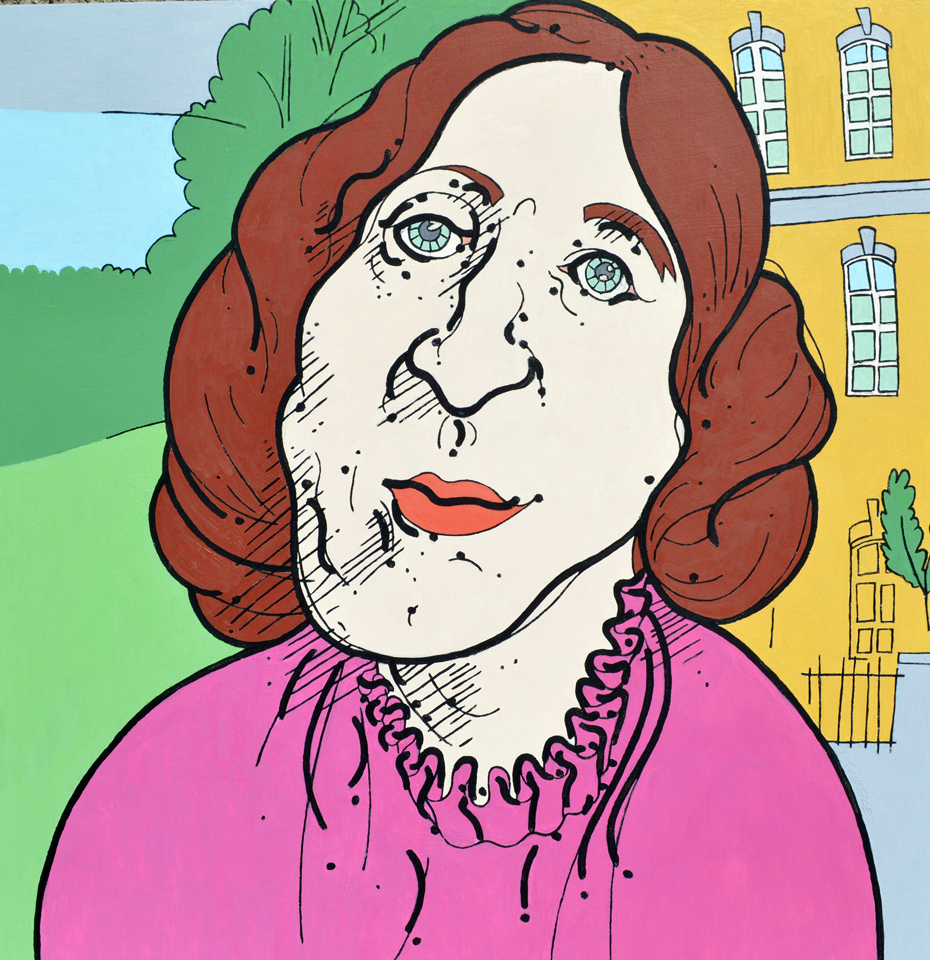
Steve Justice Painting Title: Georgy Girl: portrait of George Elliot Material: oil on wood Size: 30x30 Year: 2015 “If we had a keen vision of all ordinary life, it would be like hearing the grass grow or the squirrel’s heart beat, and we should die of the roar which lies on the other side of silence. As it is, the quickest of us walk about well-wadded with stupidity.” -- George Eliot (Mary Anne Evans) George Elliot assumed a man’s name to overcome the second-class citizenry her society forced upon women, and became one England’s finest writers. It was either that or stay locked in the attic. Behind her is pictured lush English countryside, separated by her from the London townhouse where she breathed her last. The title suggests swinging London of the 1960s (Hey there, Georgy Girl), a time that might have kinder to her.

Steve Justice Painting Title: Georgy Girl: portrait of George Elliot Material: oil on wood Size: 30x30 Year: 2015 “If we had a keen vision of all ordinary life, it would be like hearing the grass grow or the squirrel’s heart beat, and we should die of the roar which lies on the other side of silence. As it is, the quickest of us walk about well-wadded with stupidity.” -- George Eliot (Mary Anne Evans) George Elliot assumed a man’s name to overcome the second-class citizenry her society forced upon women, and became one England’s finest writers. It was either that or stay locked in the attic. Behind her is pictured lush English countryside, separated by her from the London townhouse where she breathed her last. The title suggests swinging London of the 1960s (Hey there, Georgy Girl), a time that might have kinder to her.Title: Georgy Girl: portrait of George Elliot
Material: oil on wood
Size: 30×30
Year: 2015

If we had a keen vision of all ordinary life, it would be like hearing the grass grow or the squirrel’s heartbeat, and we should die of the roar which lies on the other side of silence.  As it is, the quickest of us walks about walk about well-wadded with stupidity.     – George Elliot

George Elliot (Mary Anne Evans) assumed a man’s name to overcome the reduced status Victorian English society forced upon women (sound familiar?), and was one of the finest writers in a country of finest writers.  Her choice was to write under a pseudonym or stay locked in the attic for failing to occupy her proper sphere and act with purity, piety, submissiveness and devotion to home and hearth, and thereby falling short of the Victorian ideal of true womanhood.  Come on, George, was that really too much to ask?

Behind her is pictured the London townhouse where she breathed her last, and the lush English countryside where she breathed her best.  The title hints at swinging 1960s London (‘Hey there, Georgy Girl …’), an era that was somewhat kinder to birds.


The Birth of Dizzy Gillespie

February 7, 2015

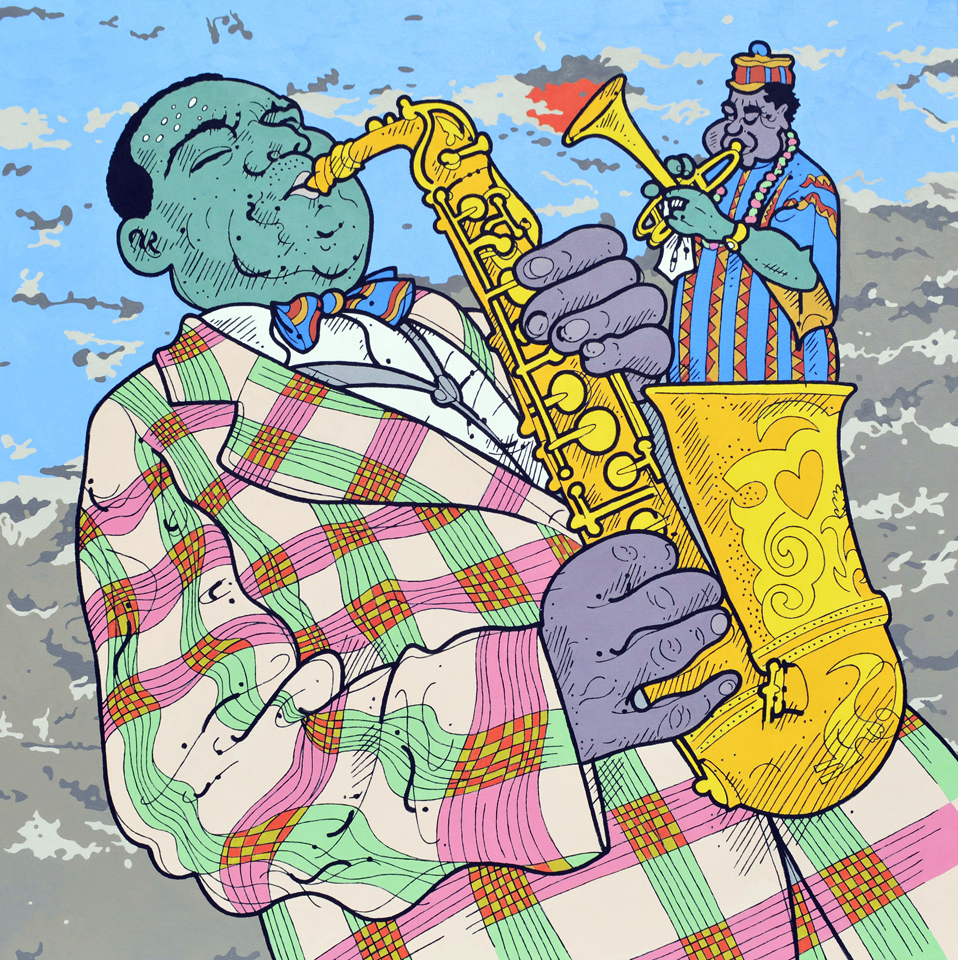
Steve Justice Painting Title: The Birth of Dizzy Gillespie Material: oil on canvas Size: 48x48 Year: 2015 “Music is your own experience, your thoughts, your wisdom. If you don’t live it, it won’t come out of your horn. They teach you there’s a boundary line to music. But, man, there’s no boundary line to art.” -- Charlie Parker I am amazed by the dazzling and maniacal music of Charlie Parker and his partner Dizzy Gillespie. Who begat who is an irrelevancy, since they suckled the same spirit and tried to turn their black-and-white times into vivid bebop dreams. The square format refers to record packaging, but the format and ragged-stripe detailing may also suggest a vintage vinyl floor tile, perhaps from a nightclub that would have staged this kind of music.

Steve Justice Painting Title: The Birth of Dizzy Gillespie Material: oil on canvas Size: 48x48 Year: 2015 “Music is your own experience, your thoughts, your wisdom. If you don’t live it, it won’t come out of your horn. They teach you there’s a boundary line to music. But, man, there’s no boundary line to art.” -- Charlie Parker I am amazed by the dazzling and maniacal music of Charlie Parker and his partner Dizzy Gillespie. Who begat who is an irrelevancy, since they suckled the same spirit and tried to turn their black-and-white times into vivid bebop dreams. The square format refers to record packaging, but the format and ragged-stripe detailing may also suggest a vintage vinyl floor tile, perhaps from a nightclub that would have staged this kind of music. The Birth of Dizzy Gillespie
Material: oil on canvas
Size: 48×48
Year: 2015

Music is your own experience, your thoughts, your wisdom.  If you don’t live it, it won’t come out of your horn.  They teach you there’s a boundary line to music.  But, man, there’s no boundary line to art.  – Charlie Parker

I have always been amazed by the dazzling and maniacal music of jazz musicians such Lester Young, Bud Powell, Max Roach, Clifford Brown, Charlie Parker, and Charlie’s partner in Bop, Dizzy Gillespie.  No, I am more than amazed – I am staggered.  Maybe something between nonplussed and thunderstruck, but short of dumb-founded.  Who begat whom, Parker or Gillespie, is irrelevant, since they drank from the same rusty can, moved north, and turned their black-and-white times into mad crazy beat American technicolor jazz dreams, man.  (Kerouac lives!  If it’s between 1922 and 1969.)

The painting’s square format refers to record packaging, but the format and ragged drag-line striping may suggest a vintage vinyl floor tile, perhaps in an Uptown jazz nightclub in the 1950’s, if you’ve ever been drunk enough to observe a floor tile this closely.

Parker wears a rumpled jacket that could only come from the 50s (or a dead sportscaster), and his bowtie borrows colors from Dizzy’s dashiki and fez.  Their skin tones were inspired by a vivid party scene I read when I was a teenager, in the Harlem Renaissance scribe Langston Hughes’ debut novel “Not Without Laughter” (1930 – he was 21 and a recent college grad), where he describes flesh tones and much else in terms of rainbows of beautiful colors.

Charlie Parker was born and is buried in Kansas City, though he spent most of his working life in New York City, where he literally died laughing as he was watching a circus act on TV.  It must have been pretty funny.


Brando Abed

February 7, 2015

Steve Justice Painting Title: Brando Abed Material: oil on canvas Size: 36x48 Year: 2015 This is a scene from “Last Tango in Paris”, depicting Marlon Brando, lying perhaps in a desert beneath some strange kind of inverted lava field so hot that it seems to burn out the line work and bleach the painting’s colors. Title: Brando Abed
Material: oil on canvas
Size: 36×48
Year: 2015

This is a scene from “Last Tango in Paris”, depicting Marlon Brando, lying perhaps in a desert beneath some strange kind of inverted lava field so hot that it seems to burn out the line work and bleach the painting’s colors.

Bend Over, Beethoven

February 7, 2015

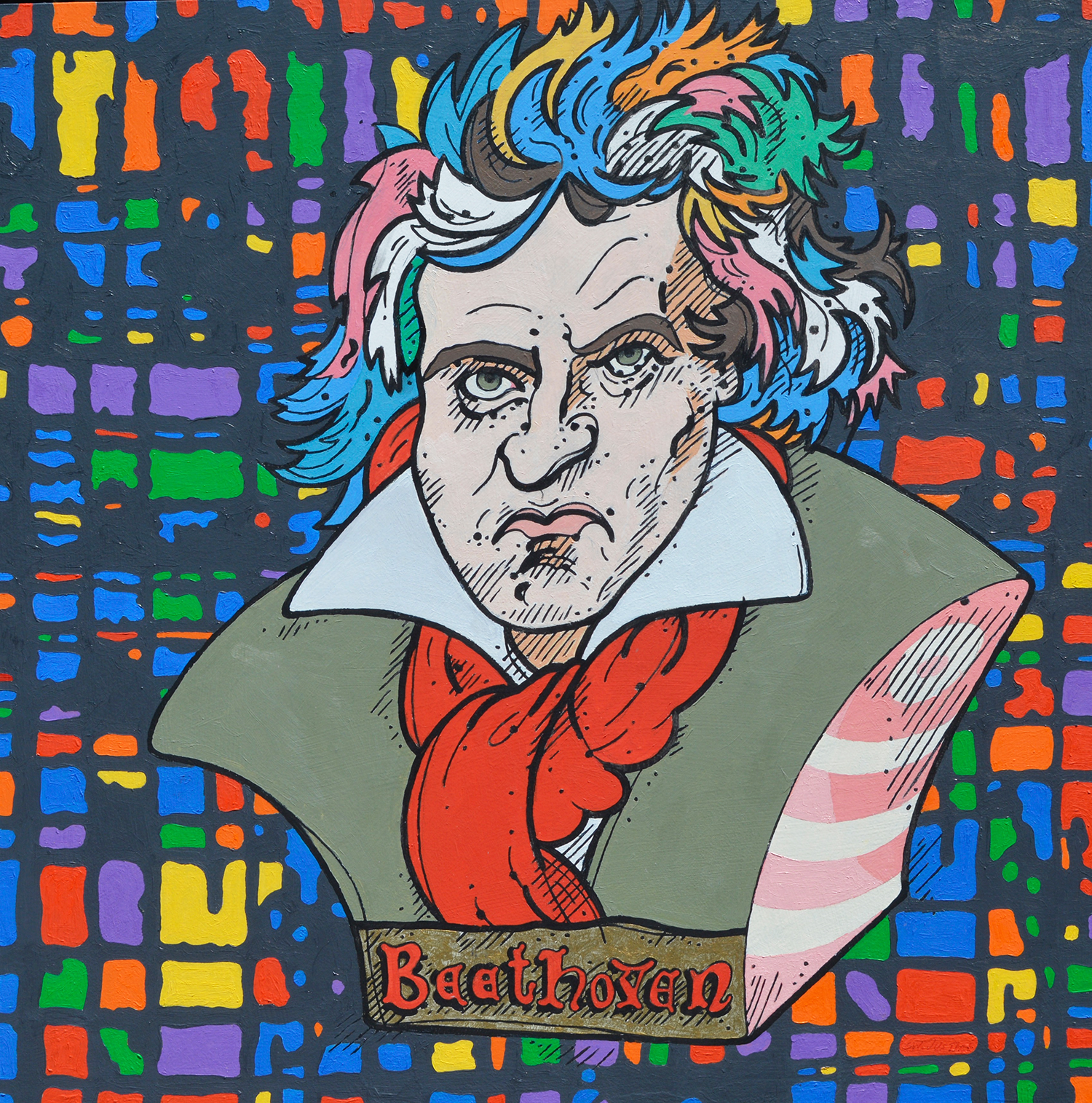
Steve Justice Painting Title: Bust o’ Beethoven Material: oil on wood Size: 30x30 Year: 2015 “You will ask where my ideas come from. I cannot say for certain. They come uncalled, sometimes independently, sometimes in association with other things. It seems to me that I could wrest them from Nature herself with my own hands, as I go walking in the woods. They come to me in the silence of the night or in the early morning, stirred into being by moods which the poet would translate into words, but which I put into sounds; and these go through my head ringing and singing and storming until at last I have them before me as notes.” -- Ludwig van Beethoven. I don’t know whether it was acute sense memory or a synesthetic ability to see music that informed Beethoven’s ability to compose such big music, though he was deaf. In this work, I re-animate his bust, here positioned in front of the clamor of colors, staffs and symbols his own ordered, disordered mind may have resembled. His wild hair is colored to suggest Milton Glaser’s iconic Bob Dylan poster.

Steve Justice Painting Title: Bust o’ Beethoven Material: oil on wood Size: 30x30 Year: 2015 “You will ask where my ideas come from. I cannot say for certain. They come uncalled, sometimes independently, sometimes in association with other things. It seems to me that I could wrest them from Nature herself with my own hands, as I go walking in the woods. They come to me in the silence of the night or in the early morning, stirred into being by moods which the poet would translate into words, but which I put into sounds; and these go through my head ringing and singing and storming until at last I have them before me as notes.” -- Ludwig van Beethoven. I don’t know whether it was acute sense memory or a synesthetic ability to see music that informed Beethoven’s ability to compose such big music, though he was deaf. In this work, I re-animate his bust, here positioned in front of the clamor of colors, staffs and symbols his own ordered, disordered mind may have resembled. His wild hair is colored to suggest Milton Glaser’s iconic Bob Dylan poster.
  Bend Over, Beethoven
Material: oil on wood
Size: 30×30
Year: 2015

You will ask where my ideas come from.  I cannot say for certain.  They come uncalled, sometimes independently, sometimes in association with other things.  It seems to me that I could wrest them from Nature herself with my own hands, as I go walking in the woods.  They come to me in the silence of the night or in the early morning, stirred into being by moods which the poet would translate into words, but which I put into sounds; and these go through my head ringing and singing and storming until at last I have them before me as notes.     – Ludwig van Beethoven

I don’t know whether it was acute sense memory, good vibrations, a synesthetic ability to see music, or a combination of the four, that enabled Beethoven to compose big music, even though he was as hearingly-challenged as a doorknob.  If he was like most people (and he wasn’t), I think he would rather have been able to hear than be heard, and for this he owes us his deepest symphonies.

This is one of my rare paintings that I set aside then returned to, in this instance three years later, to bring it up to code.  In this painting, I re-animate the maestro’s iconic bust that appears on Schoeder’s piano, as the image on the first silk-screened sweatshirt, and on most Beethoven albums.   He here sets in front of criss-crossed stanzas and symbols (as recorded in his own hand) which basically represents what he could write and play but could not hear.  To paint this background, I created a color I call “Audi Oil-change Grey”.  The clamorous background colors were randomly assigned and represent all the gaps in the music that we cannot hear but he could see.  You see?  His wild hair is colored to mimic Milton Glaser’s classic poster portrait of Bob Dylan from the 1960s.  The times they were a-changing.

I once heard a hilarious joke about Beethoven being disinterred.  He was discovered to be erasing pages of sheet music.  “I’m decomposing,” he explained.  Remind me to tell you the rest of the joke sometime.


Marilyn Monrovia

February 7, 2015

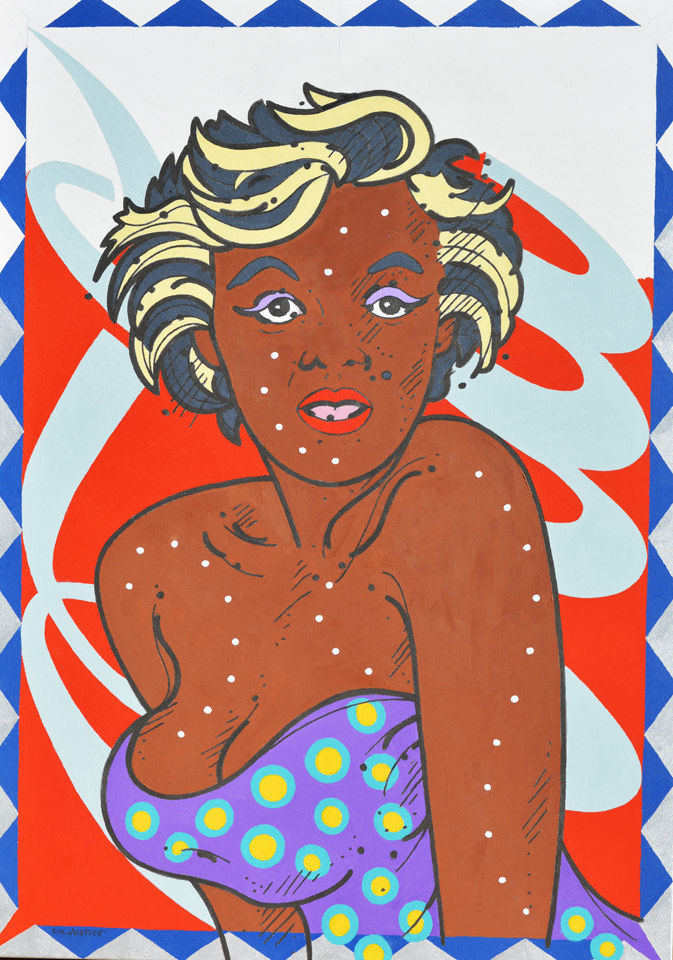
Steve Justice Paintings Title: Marilyn Monrovia Material: oil on canvas Size: 42x30 Year: 2015 “Imperfection is beauty, madness is genius and it’s better to be absolutely ridiculous than absolutely boring.” -- Marilyn Monroe I have great sensitivity toward politics and culture in Africa, and I have learned far more about western Africa in particular through their fabulous music than through my frequent reading. One result of this cultural collision is “Marilyn Monrovia”, an exploration of African and Western beauty standards, shown here with evidence of globalization looming (unfinished) on the wall behind. The red could also be thought to refer to China’s African agenda. Diamonds are a girl’s best friend, but the decorative metallic and diamond border also refers to mineral exploitation of Africa. Re. the title, Monrovia is the capital of Liberia.

Steve Justice Paintings Title: Marilyn Monrovia Material: oil on canvas Size: 42x30 Year: 2015 “Imperfection is beauty, madness is genius and it’s better to be absolutely ridiculous than absolutely boring.” -- Marilyn Monroe I have great sensitivity toward politics and culture in Africa, and I have learned far more about western Africa in particular through their fabulous music than through my frequent reading. One result of this cultural collision is “Marilyn Monrovia”, an exploration of African and Western beauty standards, shown here with evidence of globalization looming (unfinished) on the wall behind. The red could also be thought to refer to China’s African agenda. Diamonds are a girl’s best friend, but the decorative metallic and diamond border also refers to mineral exploitation of Africa. Re. the title, Monrovia is the capital of Liberia. Title: Marilyn Monrovia
Material: oil on canvas
Size: 42×30
Year: 2015

Imperfection is beauty, madness is genius and it’s better to be absolutely ridiculous than absolutely boring.     – Marilyn Monroe


I have learned a lot about the politics and culture of Africa in general, and Mali in particular, through their fabulous, spiritual music, both as recorded and in Hong Kong nightclubs.  “Marilyn Monrovia” is an exploration of Western and African beauty standards.  Depicted here is evidence of colonization and globalization, looming unfinished (or eroded) on the wall behind.  The red might also refer to China’s African agenda.  Besides being a girl’s best friend, the decorative, metallic diamonds along the border also refer to the mineral (and general) exploitation of Africa.

About the title: Monrovia is the capital of Liberia.  Liberia did everything they could to please the US, including copying our flag and naming their capital Monrovia after a well-known American shock absorber company.  They were basically declaring colonial relations with the US in order to keep our European counterparts from declaring colonial relations with them.  The US was not particularly interested in Liberia, but we weren’t about to turn down a free colony.  Besides, some Americans ignorantly considered Liberia to be an attractive destination for the re-exportation of African Americans once they outgrew their usefulness as slaves.  Without consulting Liberia about the scheme, of course.  What the hell – they wouldn’t mind.

As one South Sudanese model put it, “True beauty is born through our actions and aspirations and in the kindness we offer others.  Beauty should not be culturally relevant.  It should be universal.”  She’s right — beauty standards can co-exist.  Why not? Who’s to lose?  Nothing gained, nothing lost, and nothing wasted, nothing gained.  Everybody wins, you see.  Except those who don’t hang on my every word.  Go ahead, do it – hang on my every word.  I won’t step on your fingers.  I promise.

Etude Number 9 (or Eight Hooves to Hold Me): portrait of George Harrison

February 7, 2015

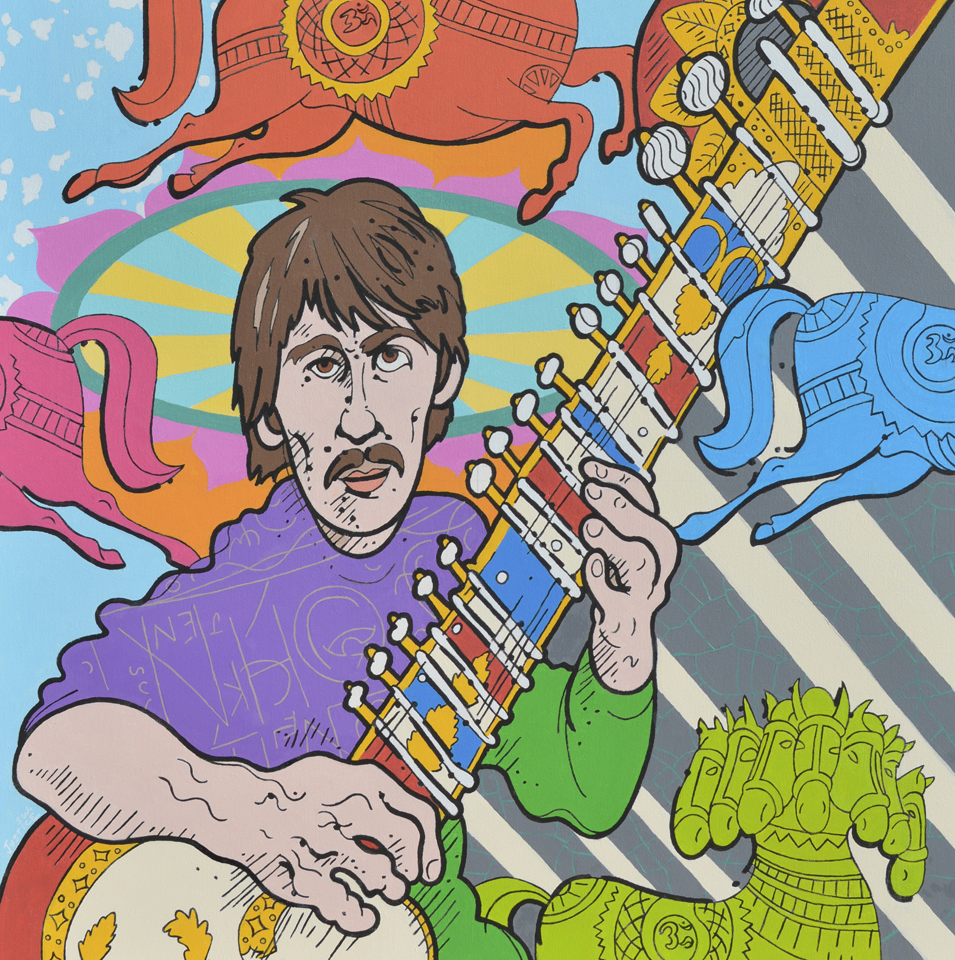
Steve Justice Painting Title: Revolution Number 4 (or Eight Hooves to Hold Me) 2 Material: oil on canvas Size: 36x36 Year: 2015 “I think people who truly live a life in music are telling the world, ‘You can have my love, you can have my smiles.’ Forget the bad parts, you don’t need them. Just take the music, the goodness, because it’s the very best, and it’s the part I give most willingly.” I became conscious of the Beatles when I was 9 after hearing their song “We Can Work It Out” on television -- until then, I didn’t know music was allowed to sound like that. I have always felt a kinship with their 20% partner George Harrison, with his work ethic, mysticism and quiet inspiration. Rich, famous, young and bored, he explored Imperial England’s oriental backwash and discovered the sitar, and introduced Eastern music to the West. I compressed my original sketch into a square format to suggest album art of the day. (Think of “Rubber Soul”.) As with almost all of my paintings, I had few preconceptions about the colors which, along with mood and some of the imagery, were inspired by a visit to India and from classical Indian storybook illustrations. Over that I layered references to the Cavern Club (actual graffiti), to Abbey Road (crosswalk stripes), to Sergeant Pepper (colored horses) etc. The subtitle, “Eight Hooves to Hold Me”, refers to the movie “Help!”s subtitle, “Eight Arms to Hold Me”.

Steve Justice Painting Title: Revolution Number 4 (or Eight Hooves to Hold Me) Material: oil on canvas Size: 36x36 Year: 2015 “I think people who truly live a life in music are telling the world, ‘You can have my love, you can have my smiles.’ Forget the bad parts, you don’t need them. Just take the music, the goodness, because it’s the very best, and it’s the part I give most willingly.” I became conscious of the Beatles when I was 9 after hearing their song “We Can Work It Out” on television -- until then, I didn’t know music was allowed to sound like that. I have always felt a kinship with their 20% partner George Harrison, with his work ethic, mysticism and quiet inspiration. Rich, famous, young and bored, he explored Imperial England’s oriental backwash and discovered the sitar, and introduced Eastern music to the West. I compressed my original sketch into a square format to suggest album art of the day. (Think of “Rubber Soul”.) As with almost all of my paintings, I had few preconceptions about the colors which, along with mood and some of the imagery, were inspired by a visit to India and from classical Indian storybook illustrations. Over that I layered references to the Cavern Club (actual graffiti), to Abbey Road (crosswalk stripes), to Sergeant Pepper (colored horses) etc. The subtitle, “Eight Hooves to Hold Me”, refers to the movie “Help!”s subtitle, “Eight Arms to Hold Me”.Title: Etude Number 9  (or Eight Hooves to Hold Me): portrait of George Harrison
Material: oil on canvas
Size: 36×36
Year: 2015

I think people who truly live a life in music are telling the world, ‘You can have my love, you can have my smiles.’  Forget the bad parts, you don’t need them.  Just take the music, the goodness, because it’s the very best, and it’s the part I give willingly.     – George Harrison

This painting was a practice piece, which is why I name it using the musical term ‘etude’.   (Whistler also named paintings using such musical terms.)  At the time I painted this, I was limited in movement and strength after I broke a couple ribs on the 4th day of the Tour de France, so I was taking it easy.  My objective here was to honor George Harrison while cramming as much Beatle arcana into the painting as it could hold.

I became conscious of the Beatles one evening when I was 9 when I hid from our sitter, Becky Bronco, and overheard, on one of her TV shows, their song “We Can Work It Out”.  It did not sound like any normal love song I’d heard before, with its doubts and insecurities, the chopping rhythm, the keyboard that drones like a broken toy Eminee organ, and that weird bridge with John Lennon speaking as the voice of reason.  Until then I didn’t know music was allowed to sound like that.  I was hooked.

George and Ringo were 20% partners in the deal.  (30% went to John and Paul.)  I have always felt a kinship with the self-described ‘Dark Horse’ George Harrison, with his work ethic, mysticism and quiet inspiration.  Rich, famous, young and bored, he explored Imperial England’s backwash and discovered the sitar, which he employed to help introduce Eastern music to the Western world.

I compressed my original sketch into a square format to suggest the distorted album art of the times, such as the Beatles’ own “Rubber Soul”.  The chaos and my colours were inspired by a visit to India and from classical Indian storybook illustration.

Note:  My subtitle “Eight Hooves to Hold Me” refers to the Beatles’ movie “HELP!” subtitle, “Eight Arms to Hold Me.”

It is a Good Day to Die

February 7, 2015

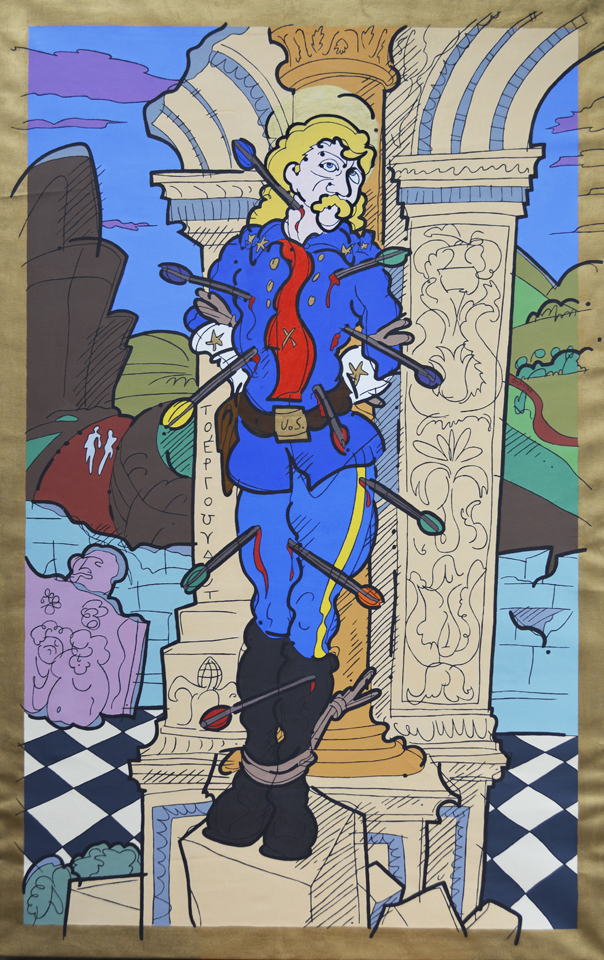
Steve Justice Paintings Title: It is a Good Day to Die Material: oil on canvas Size: 72x48 Year: 2015 “Benteen, come on, be quick. Bring packs.” -- George A. Custer (at Little Bighorn) “It is a Good Day to Die” is one of many examples of my changing a context to borrow one myth to leverage another in order to release a new energy that can then be examined. I stopped work on this comment on ambitions and mortality in 1995 due to demands for its exhibition, and finally completed it in 2015. It borrows the subject, pose and symbolism from Andrea Mantegna’s “San Sebastian”, while recasting Custer as poster child for American arrogance. This fell out of my interest in Native culture that began when teenage-me went with church missionaries out West to convert the Red Man, but returned with the opposite result. “It is a good day to die,” is a classic Lakota rallying cry. Custer’s mismatched uniform comments on the Civil War surplus he and other Indian fighters were expected to use against sometimes superior armaments.Title: It is a Good Day to Die
Material: oil on canvas
Size: 72×48
Year: 2015

There are not enough Indians in the world to defeat the Seventh Cavalry. — George Armstrong Custer

When I was a yout, I did two weeks of church mission work on a Mesquakie Indian Reservation in Iowa.  We were constantly visited with stickers and graffiti posted by Native Americans our own age reading, “Custer died for your sins.”  After I figured out what it meant, my eyes, ears and mind were opened.  I had gone to Iowa to ‘convert the native’ but the ‘natives’ converted me.  Sometimes the magic works and sometimes it wasn’t.

“Culuster’s Last Stand” is an example of my changing a context to borrow one myth to leverage another in order to present a third.  I borrowed the subject, pose and symbolism from Andrea Mantegna’s “San Sebastian” in type-casting George Armstrong Custer as a poster boy for American arrogance.  It is our last stand here, amid the ruins of a dysfunctional civilization.

Custer’s mismatched uniform comments on the Civil War surplus he and other Indian fighters were expected to use against better horsemen who frequently even had superior fire-arms.  The Sioux had their sources as well as their horses.

The word “Culuster” in the title is a Latin word meaning “asshole”.

  • Newer
  • 1
  • …
  • 6
  • 7
  • 8
  • 9
  • 10
  • …
  • 14
  • Older

Copyright 2025 Steve Justice Studio | Site design handcrafted by Station Seven