Steve Justice Studio

Art - Design

  • Home
  • Artist Statement
  • Bio and Exhibitions
  • Work
  • Contact

Anybody Here Seen My Good Friend Martin?

February 7, 2013

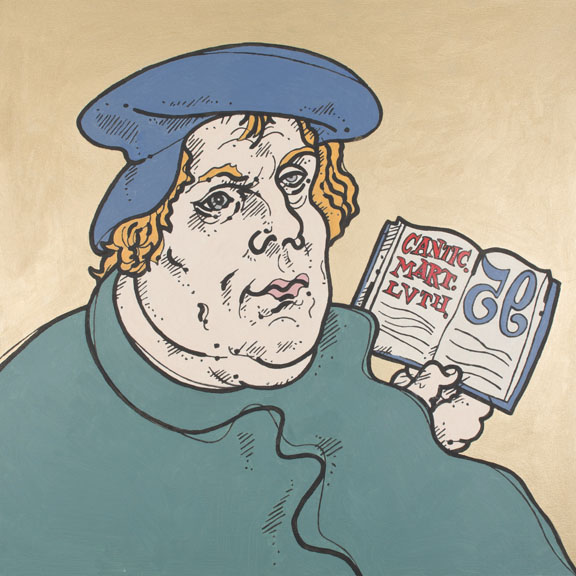
Steve Justice Painting Title: Anybody Here Seen My Good Friend Martin? Material: oil on wood Size: 30x30 Year: 2013 “When natural music is heightened and polished by art, there man first beholds and can with great wonder examine to a certain extent the great and perfect wisdom of God in his marvelous work of music.” -- Martin Luther The square wooden panel painted in gold is meant to suggest a Northern European alter-piece. The “94” refers to his 94 Theses.

Steve Justice Painting Title: Anybody Here Seen My Good Friend Martin? Material: oil on wood Size: 30x30 Year: 2013 “When natural music is heightened and polished by art, there man first beholds and can with great wonder examine to a certain extent the great and perfect wisdom of God in his marvelous work of music.” -- Martin Luther The square wooden panel painted in gold is meant to suggest a Northern European alter-piece. The “94” refers to his 94 Theses.Title: Anybody Here Seen My Good Friend Martin?
Material: oil on wood
Size: 30×30
Year: 2013    SOLD

When natural music is heightened and polished by art, there man first beholds and can with great wonder examine to a certain extent the great and perfect wisdom of God in his marvelous work of music.  – Martin Luther

It’s a good thing Martin Luther had das hodens (the balls) and the distance from Rome to push the big Reset Button the way he did.  No one should ever be afraid to do that.

The squarely square wooden panel is painted in gold to suggest a Northern European altar-piece.  The “95” refers to Luther’s 95 Theses, which he nailed to the door of the church in Wittenberg.  Some of his bullet points repeated themselves, but almost all of them were legitimate bitches.  In this painting, the hand holding the book that enumerates (but does not itemize) the Theses can’t possibly be Luther’s own hand, so it must be that of an angel or an altar boy.  I’ll go with angel.  Such messages and pointer devices occur frequently in Early Christian art, and this is Early Christian Art.
 

Longevity Has Its Place: portrait of MLK

February 7, 2013

Title: Longevity Has Its Place: portrait of MLK
Material: oil and collage on canvas
Size: 30×20
Year: 2013-2019    SOLD

“Human salvation lies in the hands of the creatively maladjusted.” — Martin Luther King

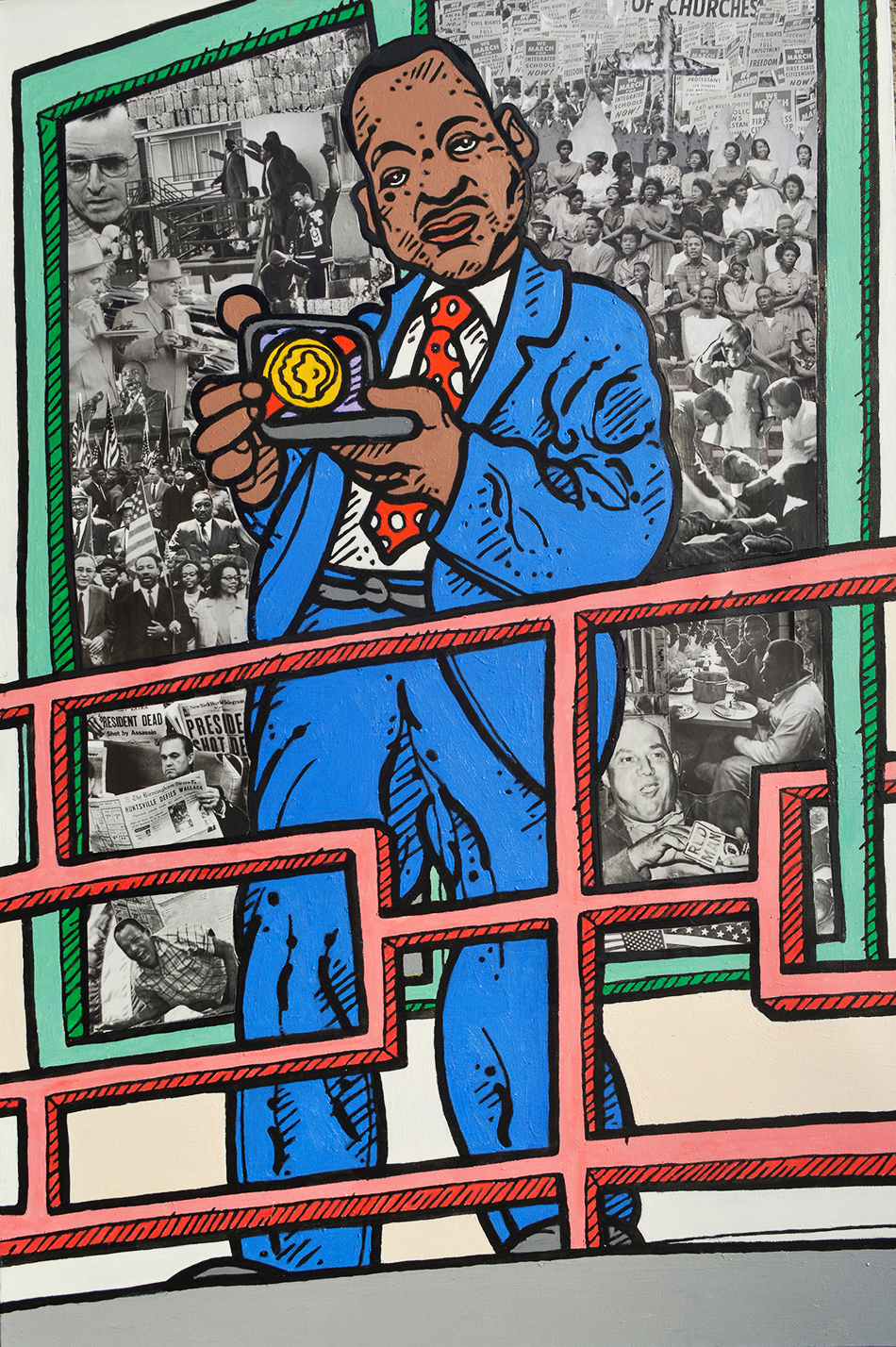
The subject himself inspired much of what I think and feel and do, and this painting is a subset of that.  Martin Luther King, Jr. stands on the balcony of the Lorraine Motel in Memphis at the time and place of his violent death, as he proudly displays the Nobel Peace Prize that he earned for his brave and diligent work for civil rights.  See how we are?  Can you see a pattern?

The painting is small and was painted in water-based oil paint, as were many of the small-space works I did when I was in Hong Kong, but it was never shown.  I felt the painting deserved better craft so 7 years later I over-painted most of it and added the collage in the windows.

The use of collage is a 1960s thing, when magazine photographers were always on the scene and the media was supplying not only the relevant themes but also the means for discussing them.  I have always been a builder of collages, the real gas being the novel combinations of mass-produced imagery to say something more or different.  It doesn’t hurt that I have a soft spot for surrealism.

I credit the African-American artist Romare Beardon with inspiring me to mix paint and paper in this composition, which is nothing new in art, but it did indicate Beardon’s early pop sensibilities and feelings of social responsibility, from his early days as a participant in the Harlem Renaissance, through the Depression, the War years, the Jim Crow ‘50s, all the way through the Civil Rights years of the 1960s.  He was present.

Injustice anywhere is injustice everywhere.

God Shave the Queen

February 7, 2013

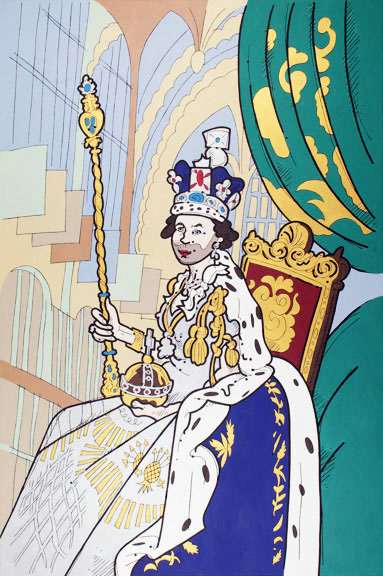
Steve Justice Painting Title: God Shave the Queen Material: oil on canvas Size: 72x48 Year: 2013 “Why say the poet and prophet are not often united? For if they are not they ought to be.” -- J.M.W. Turner When I was a toddler I had a dream so vivid that it still seems like a reality leak, in which I am in Westminster Abbey, witnessing Queen Elizabeth’s coronation. I remember noting that she seemed barely older than my baby sitter. Years later I visited England and became aware of an imbalance between the sexes in the workplace and in politics, with even a declaration by someone that Maggie Thatcher was not actually a woman. So I painted this portrait of Her Majesty sitting in what I guess is the Silly Room in a Westminster Abbey as painted in actual Martha Stewart colors. The 5-o’clock shadow and the title were an afterthought. Really.

Steve Justice Painting Title: God Shave the Queen Material: oil on canvas Size: 72x48 Year: 2013 “Why say the poet and prophet are not often united? For if they are not they ought to be.” -- J.M.W. Turner When I was a toddler I had a dream so vivid that it still seems like a reality leak, in which I am in Westminster Abbey, witnessing Queen Elizabeth’s coronation. I remember noting that she seemed barely older than my baby sitter. Years later I visited England and became aware of an imbalance between the sexes in the workplace and in politics, with even a declaration by someone that Maggie Thatcher was not actually a woman. So I painted this portrait of Her Majesty sitting in what I guess is the Silly Room in a Westminster Abbey as painted in actual Martha Stewart colors. The 5-o’clock shadow and the title were an afterthought. Really.God Shave the Queen
Material: oil on canvas
Size: 72×48
Year: 2013

Why say the poet and prophet are not often united?  For if they are not they ought to be.     – J.M.W. Turner

When I was little, I had a dream that was so vivid it still seems like some sort of reality leak than an ordinary dream, in which I was in Westminster Cathedral – great seats, too — witnessing Queen Elizabeth’s coronation.  I remember noting that she seemed barely older than my baby sitter.  Years later I visited England, and through conversation I became aware of an imbalance existing there between the sexes, in the workplace, in society and in politics.  I had to ask, how does that explain Maggie Thatcher?  I was informed that Maggie Thatcher is not a woman; that she’s really a man.  Oh … okay.  But I’ll never let that dampen my love for her.  We’ve come too far for that, right Meg?

So, I painted this portrait of the queen (“a pretty nice girl”) sitting in what must be Westminster’s Silly Room, judging from the weird perspective and Martha Stewart colors.  It’s a good thing.  The 5-o’clock shadow and the title were an afterthought, a point an art critic in Indianianapolis once missed when he panned me for wasting his precious time and scantily clad brain cells by mindlessly illustrating a grade-school level pun.  He obviously didn’t have the time or telephone privileges to call me and confirm his lazy-assed opinion, either.  If his finger was broke, he could have dialed the phone with his elbow, or had his mother dial for him.  I’ll not mention the paper’s name, so as not to embarrass myself, but it started printing in 1903, and they still think Teddy Roosevelt is the president.  Their masthead quotes 2 Corinthians 3:17, “Where the spirit of the Lord is, there is liberty,” which contradicts the beliefs and actions of many of their readers.

If an artist is rejected by one critic, it’s only one opinion.  If an artist is rejected by a 10,000 critics, it’s still only one opinion.  So don’t take criticism personally.  Either way, the artist is almost always right. Occasionally an artist has to just grab his ankles and take it.


And You Read Your Emily Dickinson

February 7, 2013

And You Read Your Emily Dickinson
Material: oil on canvas
Size: 62×48
Year: 2013

If I read a book and it makes my body so cold no fire could ever warm me, I know that is poetry.  If I feel physically as if the top of my head were taken off, I know that is poetry.  These are the only ways I know.  Is there any other way?  – Emily Dickinson                                                            

Emily Dickinson was a woman on fire, which might be why they made her live in the attic.  An attic fire is more desirable than a fire on the first floor, though neither scenario is particularly appealing.  In attic fires, firefighters may have to chop holes in your roof and pump water into your home for half an afternoon.  Your house will be filled with more water than the swimming pool at a JCC.  I’ve seen this done.

The starting point for this painting was the only photo of Emily (and even this is a dup. from a daguerreotype), the poster child for suppressed 19th-century female creative artists.  It shows that she had more vitality and better looks than do the sexless, Puritanical portraits of her that we all expect that make her look like an anorexic Wednesday Addams.  But no mere wallflower was she — her poetry is like lightning.  (And I believe she would have made the cover of Vogue were she alive today.)  She actually preferred to wear white.  Not that she needed fashion to make a statement — all she did was make statements — she was a poet!  White meant several things to her; it meant strength, energy, and radiance.  It meant ambiguity and ecstasy.  It meant hot.  It meant all colors, and white is all colors.  She read voraciously, and while other women wrote about angels, she wanted to become one.  She could pretend she was one.  So that’s why she wore white.  She didn’t have to “get real” — she lived in an attic, remember?

In this painting, she poses before wallpaper patterned with the heavens alit with 52 suns, one for every day of the week.  But, lo, a storm brews beneath the table beside her.  This rainy weather will continue into last week with highs in the late 60’s.  And notice her Bible on the table.  That’s not a bookmark sticking out of its pages – that’s the very tongue of Satan him/her/their/your/our self, smashed flat as a Boston accent.


East St. Louis Buddha-loo: portrait of Duke Ellington

February 7, 2013

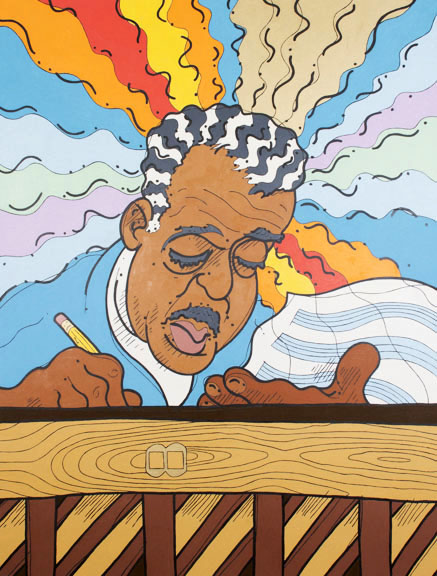
Steve Justice Painting Title: East St. Louis Buddha-loo: portrait of Duke Ellington 10 Material: oil on canvas Size: 60x48 Year: 2013 “I merely took the energy it takes to pout and wrote some blues.” -- Duke Ellington Duke Ellington’s superhuman inspiration and productivity are described here with rivers of fire and water in dialog with the universe. His hair is highlighted to suggest piano keys and to resemble the art found on vintage jazz sheet music. He wears a choir robe to remind us of the early musical workout so many black musicians received in the church. The face on the pencil is a nod to Max Fleischer, a sometimes client of the Duke. Anyone who has spent any time in grade school music class or choir practice can recognize the back of an upright piano. The title riffs on Ellington’s “East St. Louis Toodle-oo”.

Steve Justice Painting Title: East St. Louis Buddha-loo: portrait of Duke Ellington 10 Material: oil on canvas Size: 60x48 Year: 2013 “I merely took the energy it takes to pout and wrote some blues.” -- Duke Ellington Duke Ellington’s superhuman inspiration and productivity are described here with rivers of fire and water in dialog with the universe. His hair is highlighted to suggest piano keys and to resemble the art found on vintage jazz sheet music. He wears a choir robe to remind us of the early musical workout so many black musicians received in the church. The face on the pencil is a nod to Max Fleischer, a sometimes client of the Duke. Anyone who has spent any time in grade school music class or choir practice can recognize the back of an upright piano. The title riffs on Ellington’s “East St. Louis Toodle-oo”.East St. Louis Buddha-loo: portrait of Duke Ellington
Material: oil on canvas
Size: 60×48
Year: 2013

I merely took the energy it takes to pout and wrote some blues. — Duke Ellington

Duke Ellington’s outsized inspiration and productivity are described here with rivers of fire and water radiating to and/or from his head in dialog with the universe, I guess.  The Duke’s konked hair is highlighted to suggest piano keys and to also resemble the Art Deco graphics found on vintage jazz sheet music, though he’s more the elder statesman here.  Duke wears a choir robe to remind us of the early, sacred musical workout so many black (and white) musicians received by singing in the church.  The face on the pencil is lighthearted sport, and also a nod to the cartoons of Max Fleischer, whose art often involved the animation of inert objects.  His soundtracks almost always included early jazz.  The title riffs on Ellington’s song “East St. Louis Toodle-oo”, the song that features Bubber Miley’s growling, muted “wha-wha” trumpet sound for which he was well-known.  He was also known as being one of the three best trumpet players in the business, along with Bix Beiderbecke and Louis Armstrong.  Bubber died of tuberculosis at 29, and Bix died of pneumonia at 28, leaving through sheer talent (and some default) the undisputed king of the jazz trumpet.  When asked to comment on his fortune, Armstrong once said, “Za-Za-Za-Za-Zot!”

Anyone who has spent any time in grade school music class (or a brothel) can recognize the back of an upright piano.  Music teachers can see right through an upright piano, was my takeaway from music class.   Another was that my music teacher didn’t care how well I could draw – music class was for music, not doodling.

Was Duke a buddha?  Or maybe a boddhisatva?  In a sense, perhaps, but making sense is not part of an artist’s job description.  In my case, it rarely is.  You’re welcome.  But, getting back to the buddha/boddhisatva question, the answer is I don’t know.  Maybe we can ask the music teacher when she’s in a better mood, but I think this is as good as it gets.


Rust Belt Hero: portrait of Roberto Clemente

February 7, 2013

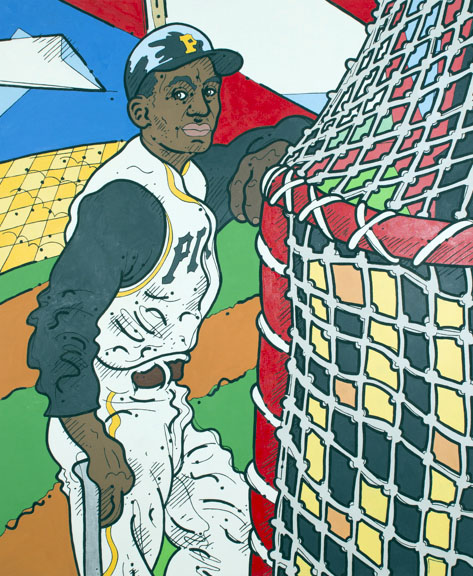
Steve Justice Painting Title: Rust Belt Hero: portrait of Roberto Clemente Material: oil on canvas Size: 58x48 Year: 2013 “When I wake up in the morning, I pray I am still sleeping.” -- Roberto Clemente Pittsburgh Pirates outfielder Roberto Clemente was baseball’s first Latino superstar. With his ascendancy the game became faster and the flat-footed Yankee-style of baseball became a thing of the past. Though his organization was (and still is) racially progressive in nature, Clemente had to deal with much of the same discrimination, miscommunication and cultural disconnect that other immigrants feel. In this painting he knows we’re here to watch him hit baseballs, something he does very well. The digital numerals before him hint at the new, electronic sport that lies ahead, but here the hero waits in hokey old Forbes Field, which is shattered into the colors of the Caribbean, of major league stadium sports, and of the flag of Puerto Rico.

Steve Justice Painting Title: Rust Belt Hero: portrait of Roberto Clemente Material: oil on canvas Size: 58x48 Year: 2013 “When I wake up in the morning, I pray I am still sleeping.” -- Roberto Clemente Pittsburgh Pirates outfielder Roberto Clemente was baseball’s first Latino superstar. With his ascendancy the game became faster and the flat-footed Yankee-style of baseball became a thing of the past. Though his organization was (and still is) racially progressive in nature, Clemente had to deal with much of the same discrimination, miscommunication and cultural disconnect that other immigrants feel. In this painting he knows we’re here to watch him hit baseballs, something he does very well. The digital numerals before him hint at the new, electronic sport that lies ahead, but here the hero waits in hokey old Forbes Field, which is shattered into the colors of the Caribbean, of major league stadium sports, and of the flag of Puerto Rico.Title: Rust Belt Hero: portrait of Roberto Clemente
Material: oil on canvas
Size: 58×48
Year: 2013

When I wake up in the morning, I play I am still sleeping.     – Roberto Clemente

One of my earliest memories is of my mother setting up her ironing and other chores in the fallout shelter, so that she could watch the 1960 World Series between the hometown favorites, the Pittsburgh Pirates and the big, bad Bombers from Bronx, the New York Yankees.  She bought me a puzzle to occupy myself during the Series, which she instructed me could only be assembled on the wall, so I spent 9 days chasing puzzle pieces around the room. My 6-year-old brother re-read and annotated his Tolstoy, started on Mencken, then started on edits on his upcoming address to the joint chambers of Congress.  My mother ironed and re-ironed our clothes until they were stiff as plywood.  I could barely pry apart my t-shirts after she ironed them, let alone wear them.

Pittsburgh Pirates outfielder Roberto Clemente was baseball’s first Latino superstar.  Though his team was (and still is) racially progressive in its philosophy, Clemente had to deal with much of the same discrimination, miscommunication and cultural disconnect that other immigrants feel.  We kids were encouraged to admire the slick white infielders, but it was the dark outfielders who were doing the heavy lifting.

In this painting, Clemente eyes us like a thoroughbred.  He was the Seabiscuit of baseball in that his form was poor but he was effective.  He knows we’re here to watch him hit, field and throw baseballs, something he did very well.

The digital numbers here magically appearing before him hint at the new, electronic sport that would arrive a few years after this picture was taken.  In the meantime, he waits in hokey old Forbes Field, which is here shattered as if by a hurricane into the colors of the Caribbean and of Major League stadium sports.

You Don’t Know Joe Sibbitt

February 7, 2013

Steve Justice Painting Title: You Don’t Know Joe Sibbitt Material: oil on canvas Size: 30x24 Year: 2013 “There never was a great character who did not sometimes smash the routine regulations and make new ones for himself.” -- Andrew Carnegie Joe Sibbitt is a fictitious any-man in the blue-collar Pittsburgh I grew up in. Someone might actually know someone who knows him, since all Pittsburghers seem to be related by only 2-3 degrees of separation. The bigger-than-man machinery, the dirt, the rivers, the twinkling lights and the houses clinging to hillsides, were all things I grew up with and took for granted.

Steve Justice Painting Title: You Don’t Know Joe Sibbitt Material: oil on canvas Size: 30x24 Year: 2013 “There never was a great character who did not sometimes smash the routine regulations and make new ones for himself.” -- Andrew Carnegie Joe Sibbitt is a fictitious any-man in the blue-collar Pittsburgh I grew up in. Someone might actually know someone who knows him, since all Pittsburghers seem to be related by only 2-3 degrees of separation. The bigger-than-man machinery, the dirt, the rivers, the twinkling lights and the houses clinging to hillsides, were all things I grew up with and took for granted.
Title: You Don’t Know Joe Sibbitt
Material: oil on canvas
Size: 30×24
Year: 2013

There never was a great character who did not sometimes smash the routine regulations and make new ones for himself.     – Andrew Carnegie

When I had just turned 18, I worked nights at J&L (later LTV) Steel’s Hazelwood (Pittsburgh) by-products plant, usually shoveling up the damp, crushed coal with which the coke ovens were charged.  I would spend what down-time I had sitting high on a balcony overlooking the river, reading the Sporting News and enjoying the man-made beauty that only a Rustbelt boy could appreciate.   What a show.  A celestial firmament of lights twinkled in the hills along the rivers, and Downtown glowed like Oz down around the riverbend.  I would often see a horizontal shaft of light materialize over the river, that would intensify for ten minutes until its source, a towboat pushing a dozen barges filled with peirogies, would grind its way past.  I could hear any train in the valley and could almost count the number of cars just from its sound.

“Joe Sibbitt” of the title is a fictitious any-man in blue-collar Pittsburgh (or any other Rust Belt town).  Someone might know someone who knows his neighbor’s sister, since all Pittsburghers are removed from one-another by only a couple degrees of separation.  The bigger-than-thou machinery, the dirt, the rivers, the rust, the lights twinkling in the smog, and the houses clinging to the hillsides; these were all things we grew up with and took for granted that the resta yins might git if ya weren’t sucha buncha jaggoffs.


The Abduction of Clueless Joe Jackson

February 7, 2013

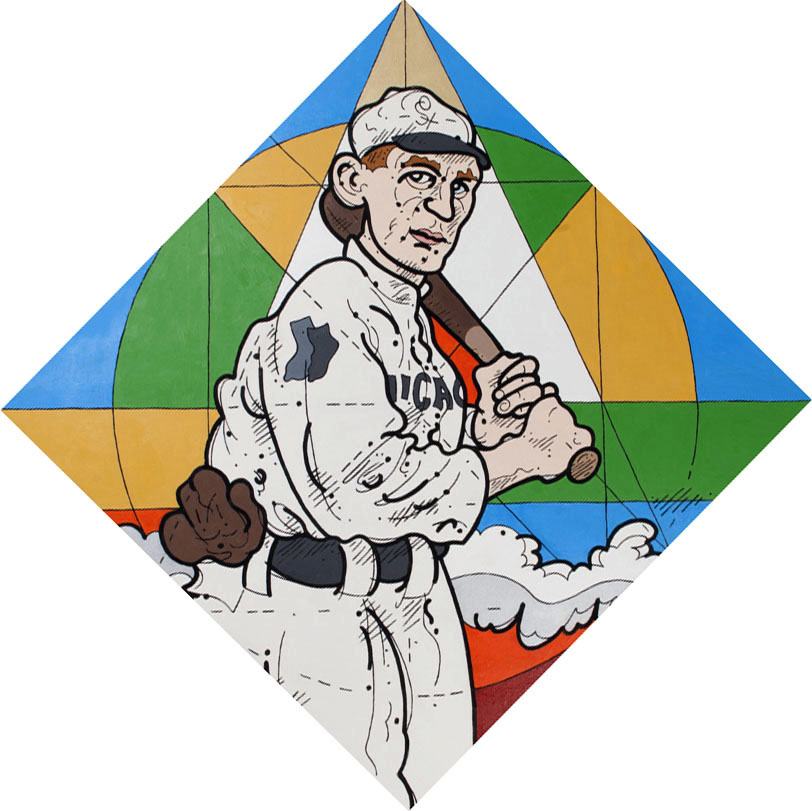
Steve Justice Painting Title: The Abduction of Clueless Joe Jackson 9 Material: oil on canvas Size: 51x51 Year: 2013 “I ain’t afraid to tell the world that it don’t take school stuff to help a fella play ball.” -- Shoeless Joe Jackson Gaze with sympathy at an illiterate savant who, in spite of his talents, found himself in circumstances beyond his simple understanding of the world (the “Black Sox Scandal”). Shoeless Joe Jackson struck out only 186 in 13 major league seasons – some of today’s players strike out that many times by August. In this painting, the unique analysis and geometry of baseball is reiterated through line work and the diamond format. Is that a renaissance light of inspiration over his head? Or is it a dunce cap? Or is it some sort of tractor beam? Is that hell below? We may never know.

Steve Justice Painting Title: The Abduction of Clueless Joe Jackson 9 Material: oil on canvas Size: 51x51 Year: 2013 “I ain’t afraid to tell the world that it don’t take school stuff to help a fella play ball.” -- Shoeless Joe Jackson Gaze with sympathy at an illiterate savant who, in spite of his talents, found himself in circumstances beyond his simple understanding of the world (the “Black Sox Scandal”). Shoeless Joe Jackson struck out only 186 in 13 major league seasons – some of today’s players strike out that many times by August. In this painting, the unique analysis and geometry of baseball is reiterated through line work and the diamond format. Is that a renaissance light of inspiration over his head? Or is it a dunce cap? Or is it some sort of tractor beam? Is that hell below? We may never know. Title: The Abduction of Clueless Joe Jackson
Material: oil on canvas
Size: 51×51
Year: 2013

I ain’t afraid to tell the world that it don’t take school stuff to help a fella play ball.   – Shoeless Joe Jackson

Hurray, hurray!  Step right up folks, and gaze with unabashed sympathy at an illiterate athletic savant who, in spite of his God-given talents, found himself in circumstances beyond his simple understanding of the world, which was the Black Sox Scandal, in which several White Sox players colluded to throw the 1919 World Series in exchange for riches.  “Let’s light this scandal!” Joe shouted, and everyone else groaned.  They learned the old lesson the hard way, that their boss (Walter Comisky) might not always be right, but he was always boss.

Joe Jackson struck out only 186 times in 13 major league seasons, which is something like only twice a month, for those of you who are scoring at home.  Vince Dimaggio struck out that much every year.  His brother Joe only struck out with Hollywood super-starlets.  Some modern players strike out that many times by August.  Jackson has baseball’s second-highest career batting average, a few points behind Ty Cobb.  But (sigh), there is no Hall of Fame for anyone dumber than Dizzy Dean.

In this painting, the analysis, geometry and extreme calculation particular to baseball are iterated through line, color and the diamond format.  Is that hell below?  Is that a light of inspiration over Joe’s head, or is it a dunce cap?  Or maybe some sort of tractor beam?  No, I’m pretty sure he plowed with mules, so it can’t be a tractor beam.  Jimmy Carter plowed with mules when he was young, too, plus he ate more opossum than he cares to admit.  He said so.

So, there’s a right and a wrong question to every answer, and it’s up to us to find out what it is.  The take-away, kids, is STAY IN SCHOOL!   Learning never ends.  And, yes, this will be on the test.


Saint Stonewall of Shenanidoah

February 7, 2013

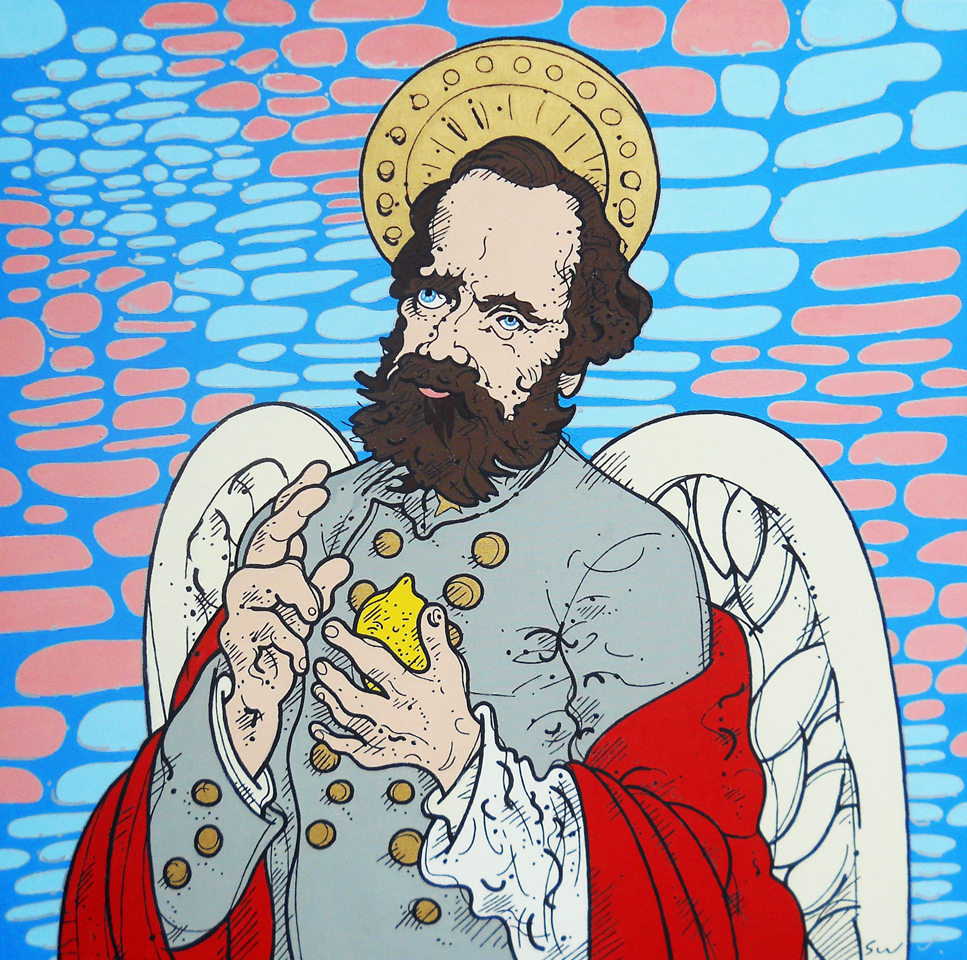
Steve Justice Title: Saint Stonewall of Shenanidoah Material: oil on canvas Size: 46x46 Year: 2013 “Mystery, mystery, is the secret to success.” -- Thomas L. “Stonewall” Jackson My ancestors fought in the Civil War for the North’s Virginia/West Virginia Volunteers, who had their asses kicked up and down the Shenandoah Valley by the crafty tactician, rebel mystic and symbol of “the cause”, Stonewall Jackson, here deified in Christ-pose with a heart of lemon. (Lemons were his favorite snack.) The battle flag of the secession states is subtly suggested in the stonewall clouds in the sky.

Steve Justice Title: Saint Stonewall of Shenanidoah Material: oil on canvas Size: 46x46 Year: 2013 “Mystery, mystery, is the secret to success.” -- Thomas L. “Stonewall” Jackson My ancestors fought in the Civil War for the North’s Virginia/West Virginia Volunteers, who had their asses kicked up and down the Shenandoah Valley by the crafty tactician, rebel mystic and symbol of “the cause”, Stonewall Jackson, here deified in Christ-pose with a heart of lemon. (Lemons were his favorite snack.) The battle flag of the secession states is subtly suggested in the stonewall clouds in the sky. Saint Stonewall of Shenanidoah
Material: oil on canvas
Size: 46×46
Year: 2013

Mystery, mystery is the secret to success.     – Thomas L. “Stonewall” Jackson

My ancestors fought in the Civil War for the Virginia (West Virginia) Volunteers, who represented the North and got their asses kicked up and down the Shenandoah Valley by the crafty, unpredictable tactician, Rebel holy man, and poster-boy for the Lost Cause, Thomas “Stonewall” Jackson, here mockingly deified in Christ-pose with a heart of lemon (which was his favorite snack, and I reckon hard to come by in the mid-19th century), and the red robe, wings, and halo customarily assigned to saints in such situations.   Those on the losing end of this futile rebellion actually thought that highly of him.  Many of his fans still make that mistake, after 160 years.

The eyesore known as the battle flag of the secession states is subtly suggested in the faded, stonewall-like clouds in the sky.  Stonewall’s missing button is a reference to a tale in which one was removed by him as a souvenir for a young girl named Girl.  Her brother, Mordechai, got to keep Stonewall’s baseball mitt, which was useless to the general after he lost his arm, but I’m getting ahead of myself.

Jackson was killed by friendly fire (yeah, real fucking friendly) about halfway through the war, at the Battle of Chancellorsville in 1863, which he won for Lee through a staggering display of creative generalship.  His army of 14,000 tiptoed, undetected, around “Fighting Joe” Hooker’s camps at night (you try walking 13 miles through mud and horseshit on tip-toe) and undertook the mother of all panty raids.  Hooker was doing more drinking than fighting around that time, and his detachment of only 115,000 trained, armed, and well-rested soldiers were routed.  After he fell, Jackson’s arm was buried near Chancellorsville, but the rest of him was buried near his home in Lexington, Virginia.  His horse Sorrel is stuffed and on display at the Virginia Military Institute (VMI) museum, for inspection by anyone interested in 19th century taxidermy.


Kruschev at the Beach

February 7, 2013

Steve Justice Painting Title: Kruschev at the Beach Material: oil on canvas Size: 36x36 Year: 2013 “Progressive artists are faggots, traitors and agents of imperialism.” -- Nikita Kruschev It’s not Don Rickles so it must be Kruschev. “Kruschev at the Beach” is my out-take from all those photos of Nikita Kruschev staring dumbly at stuff while he was touring the U.S.

Steve Justice Painting Title: Kruschev at the Beach Material: oil on canvas Size: 36x36 Year: 2013 “Progressive artists are faggots, traitors and agents of imperialism.” -- Nikita Kruschev It’s not Don Rickles so it must be Kruschev. “Kruschev at the Beach” is my out-take from all those photos of Nikita Kruschev staring dumbly at stuff while he was touring the U.S.Title: Kruschev at the Beach
Material: oil on canvas
Size: 36×36
Year: 2013      SOLD

Progressive artists are faggots, traitors and agents of imperialism.   — Nikita Kruschev

“Kruschev at the Beach” is my out-take from all those photos from the 1950s of the Savior of Stalingrad himself staring distractedly at stuff while he and VP Richard Nixon toured the US:  a modern kitchen, monuments to people he never heard of, Dick’s dog Checkers, Checker’s dog Dick and, here, the beach (the South Jersey Shore, to be exact).  My working title was “Nikita Banana”, but Kruschev apparently didn’t like fruits, which you already know if you’ve been paying any attention at all.  He was a borsht and vodka kind of guy.

  • Newer
  • 1
  • …
  • 8
  • 9
  • 10
  • 11
  • 12
  • …
  • 14
  • Older

Copyright 2025 Steve Justice Studio | Site design handcrafted by Station Seven